Support our educational content for free when you purchase through links on our site. Learn more
🎮 8 Real-World Design Patterns Powering Your Favorite Games (2026)

Your favorite games and apps run on invisible blueprints called design patterns, with the Observer and State patterns serving as the backbone for everything from Fortnite updates to Mario jumps. When you ask What are some examples of real-world applications of design patterns in popular apps and games?, the answer lies in the code that keeps your Spotify playlists synced and your Minecraft worlds infinite.
We once watched a junior developer try to build a character controller using hundreds of nested if/else statements, only to watch it collapse under its own weight. The solution? A simple State Pattern that separated “running,” “jumping,” and “falling” into distinct, manageable classes. This isn’t just theory; it’s the difference between a game that crashes and one that sells millions of copies.
Did you know that Red Dead Redemption 2 uses the Flyweight Pattern to render millions of trees without melting your GPU? It shares a single tree model in memory and simply changes its position and rotation for every instance. That’s the magic of patterns: they turn impossible problems into elegant solutions.
Key Takeaways
- Real-world impact: Patterns like Observer and Strategy are the secret sauce behind real-time updates in Discord and dynamic AI in XCOM.
- Performance boost: The Flyweight and Singleton patterns are critical for managing memory in massive open worlds like GTA V and World of Warcraft.
- Maintainability: Using the Command and Factory patterns allows developers to add features (like “Undo” in Photoshop) without rewriting entire codebases.
- Avoid over-enginering: While powerful, patterns must be applied with context; blindly forcing them can lead to anti-patterns that complicate your code.
Table of Contents
- ⚡️ Quick Tips and Facts
- 📜 From Gang of Four to Game Changers: A Brief History of Design Patterns
- 🏗️ The Architect’s Blueprint: Why Patterns Matter in Modern Software
- 🎮 Real-World Game Design Patterns: How Your Favorite Titles Are Built
- 1. The Observer Pattern: How Fortnite and Discord Handle Real-Time Updates
- 2. The State Pattern: Mastering Character Logic in Mario and Zelda
- 3. The Singleton Pattern: Managing Global Resources in World of Warcraft
- 4. The Command Pattern: Undoing Mistakes in Photoshop and Civilization
- 5. The Factory Pattern: Procedural Generation in Minecraft and No Man’s Sky
- 6. The Strategy Pattern: AI Behavior in StarCraft and XCOM
- 7. The Flyweight Pattern: Rendering Massive Worlds in GTA V and Red Dead Redemption 2
- 8. The Composite Pattern: Building Complex UIs in React and Unity
- 📱 Mobile & Web App Patterns: The Invisible Engines Behind Your Daily Apps
- 1. The MVC and MVM Patterns: The Backbone of Instagram and Twitter
- 2. The Repository Pattern: Data Management in Spotify and Netflix
- 3. The Adapter Pattern: Integrating Third-Party APIs in Uber and Airbnb
- 4. The Decorator Pattern: Dynamic Feature Toggling in Slack and Zoom
- 🛠️ Anti-Patterns: When Good Patterns Go Bad in Production
- 🧠 Choosing the Right Pattern: A Decision Matrix for Developers
- 🚀 Future Trends: Design Patterns in AI, Cloud, and Serverless Architectures
- 🎓 Conclusion
- 🔗 Recommended Links
- ❓ FAQ
- 📚 Reference Links
⚡️ Quick Tips and Facts
Before we dive into the codebases of giants like Fortnite and Instagram, let’s hit the pause button on theory and get straight to the “why” and “how” that actually matters in the trenches.
- Design patterns aren’t magic spells. They are reusable solutions to common problems, but applying them blindly is a recipe for over-enginering. As the old saying goes, “If all you have is a hammer, everything looks like a nail.”
- The “Gang of Four” (GoF) isn’t a secret society of hackers; it’s the nickname for the four authors of the 194 bible Design Patterns: Elements of Reusable Object-Oriented Software. Their work laid the foundation for modern software architecture, including the patterns we see in your favorite apps today.
- Patterns save time, not just lines of code. By using a proven structure, you reduce the cognitive load on your team. Everyone knows how the Observer pattern works, so you don’t have to explain the logic from scratch.
- Context is king. A pattern that works beautifully in a turn-based strategy game might be a disaster in a real-time multiplayer shooter.
- Anti-patterns are real. Sometimes, the solution you reach for is actually a trap. We’ll cover those later, but remember: premature optimization is the root of all evil.
For a deeper dive into the philosophy behind these structures, check out our guide on coding design patterns at Stack Interface™.
📜 From Gang of Four to Game Changers: A Brief History of Design Patterns

It all started in the 1970s and 80s, when software engineering was a bit of a wild west. Developers were reinventing the wheel for every new project, leading to code that was brittle, hard to read, and impossible to maintain. Enter Christopher Alexander, an architect who wrote A Pattern Language, describing how humans interact with buildings. He argued that good design follows recurring patterns.
Fast forward to 194, and four software engineers—Erich Gamma, Richard Helm, Ralph Johnson, and John Vlissides (the famous Gang of Four)—adapted Alexander’s architectural concepts for object-oriented programming. They cataloged 23 classic patterns.
But here’s the twist: the book was written for C++ and Smalltalk, languages that felt very different from the JavaScript, Swift, and C# we use today. Yet, the core problems remained the same:
- How do I create objects without hardcoding their classes? (Creational)
- How do I connect objects without making a mess of dependencies? (Structural)
- How do I manage communication between objects without tight coupling? (Behavioral)
Over the decades, these patterns evolved. In the world of game development, patterns like the State Pattern became essential for handling character logic. In mobile apps, the MVC (Model-View-Controller) pattern became the standard for separating UI from data.
“Design patterns are typically solutions to common problems in software design.” — First Video Perspective
The beauty of these patterns is their language-agnostic nature. Whether you are building a backend for a banking app in Java or a mobile game in Unity, the Strategy Pattern solves the same problem: swapping algorithms at runtime.
🏗️ The Architect’s Blueprint: Why Patterns Matter in Modern Software
Why should you, a developer or a curious tech enthusiast, care about these abstract concepts? Imagine building a skyscraper without blueprints. You might get the first floor up, but the 50th floor? Good luck.
Design patterns provide that blueprint. They offer:
- Scalability: As your app grows from 10 users to 10 million, patterns ensure your code doesn’t collapse under its own weight.
- Maintainability: New developers can jump into your codebase and understand the structure immediately because they recognize the Factory or Singleton pattern.
- Flexibility: Need to swap out a payment gateway? With the Adapter Pattern, you can do it without rewriting the entire checkout flow.
However, there’s a catch. As noted in the “First Video” perspective, “You actually need to use your brain to implement them.” Blindly copying a pattern without understanding the problem it solves leads to spaghetti code wrapped in a fancy design pattern.
The Three Pillars of Patterns
To keep things organized, we categorize them into three buckets:
| Category | Focus | Key Patterns | Real-World Analogy |
|---|---|---|---|
| Creational | Object creation | Singleton, Factory, Builder | A car factory deciding how to assemble different models. |
| Structural | Object composition | Adapter, Decorator, Facade | Using a power strip to connect multiple devices to one outlet. |
| Behavioral | Communication | Observer, Strategy, State | A traffic light system coordinating cars and pedestrians. |
🎮 Real-World Game Design Patterns: How Your Favorite Titles Are Built
Games are the ultimate testbed for design patterns. They are complex, real-time systems where performance and logic must dance in perfect sync. Let’s break down how the titans of the industry use these patterns to keep players hooked.
1. The Observer Pattern: How Fortnite and Discord Handle Real-Time Updates
Imagine you’re playing Fortnite. The storm is closing in, your health is low, and a squadmate just called out an enemy. How does the game know to update your UI, play a sound, and notify your teammates simultaneously?
Enter the Observer Pattern.
In this pattern, an object (the Subject) maintains a list of its dependents (the Observers) and notifies them automatically of any state changes.
-
How it works in Fortnite:
Subject: TheGameWorldobject.
Observers: TheHUD,AudioManager,NetworkManager, andAchievementSystem.
Event:OnStormDamageTaken.
Result: When the player takes damage, theGameWorldbroadcasts this event. TheHUDupdates the health bar, theAudioManagerplays a hit sound, and theNetworkManagersends the data to the server. -
Why it’s brilliant: The
GameWorlddoesn’t need to know who is listening. It just shouts, “Hey, someone got hit!” This decouples the core logic from the presentation layer. -
The Downside: If you aren’t careful, you can end up with “spaghetti observers” where an event triggers a chain reaction that crashes the game. It’s crucial to manage subscriptions carefully.
Pro Tip: In modern engines like Unity, this is often implemented via Events or C# Delegates.
2. The State Pattern: Mastering Character Logic in Mario and Zelda
Remember the frustration of “air jumping” in old platformers? Or a character trying to run while swimming? That’s usually a failure of state management.
The State Pattern allows an object to change its behavior when its internal state changes. Instead of a giant if/else block checking if (isJumping && !isGrounded), you have distinct classes for each state.
-
*Case Study: Super Mario Bros.:*
States:IdleState,RunningState,JumpingState,DuckingState.
Implementation: Each state class implements anHandleInput()method. -
In
IdleState, pressing “Jump” transitions toJumpingState. -
In
JumpingState, pressing “Jump” does nothing (no double jump in the original). -
In
DuckingState, pressing “Run” transitions toRunningState. -
The “Spaghetti Code” Problem Solved: Without this pattern, you’d have hundreds of boolean flags (
isDucking,isSwimming,isOnFire) and nested conditions. The code would be unmaintainable. -
Advanced Usage: Modern games use Hierarchical State Machines (HSMs). For example, in The Legend of Zelda,
OnGroundStateis a parent state forRunning,Walking, andIdle. If you press “Jump” in any of those, it transitions toJumpingState. This reduces code duplication significantly.
3. The Singleton Pattern: Managing Global Resources in World of Warcraft
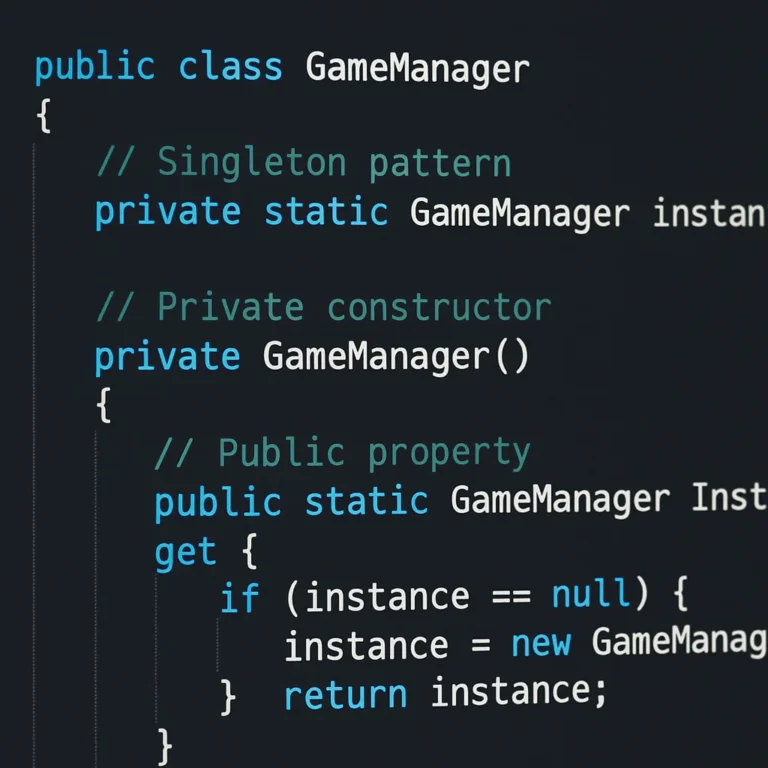
There can only be one. That’s the rule of the Singleton Pattern. It ensures a class has only one instance and provides a global point of access to it.
-
Where it’s used:
Game Managers: In World of Warcraft, theGameManagerorAudioManageris a singleton. You don’t want two audio managers playing different versions of the same soundtrack.
Configuration: Loading the game settings file once and accessing it globally. -
The Controversy: Many developers hate Singletons because they introduce global state, which makes testing difficult and creates hidden dependencies.
Counter-argument: In game development, where you need instant access to resources like theInputManagerorSaveSystem, Singletons are often a pragmatic necessity. -
Real-World Example: In Minecraft, the
Worldobject is effectively a singleton within a session. You can’t have two different worlds loaded in the same client instance without complex multi-threading.
4. The Command Pattern: Undoing Mistakes in Photoshop and Civilization
Ever hit “Undo” in Photoshop or Civilization and wondered how it works? That’s the Command Pattern in action.
-
The Concept: It encapsulates a request as an object, allowing you to parameterize clients with queues, requests, and operations. It supports undo/redo functionality.
-
How it works in Civilization VI:
-
Every action (move unit, build city, attack) is a
Commandobject. -
The
Commandhas anExecute()method and anUndo()method. -
When you make a move, the game pushes the command onto a stack.
-
When you hit “Undo,” it pops the command and calls
Undo(). -
Why it’s essential: It decouples the object that invokes the operation (the UI button) from the object that knows how to perform it (the game logic).
5. The Factory Pattern: Procedural Generation in Minecraft and No Man’s Sky
How does Minecraft generate infinite worlds without crashing your computer? It doesn’t store every block. It uses the Factory Pattern (and related Creational patterns) to generate objects on the fly.
-
The Mechanism:
-
A
BlockFactorytakes a seed and coordinates. -
It decides what type of block to create (Stone, Dirt, Diamond Ore) based on the algorithm.
-
It returns the specific
Blockobject. -
In No Man’s Sky: The game uses a complex factory system to generate planets, flora, and fauna. The
PlanetFactorycreates a planet object, which then uses sub-factories to populate it with trees and animals. -
Benefit: You don’t need to know the specific class of the object you’re creating, just the interface. This makes the code highly extensible.
6. The Strategy Pattern: AI Behavior in StarCraft and XCOM
How does the AI in StarCraft decide to rush you or build a base? It uses the Strategy Pattern.
-
The Concept: Defines a family of algorithms, encapsulates each one, and makes them interchangeable.
-
In XCOM:
-
The AI has different strategies:
AgressiveStrategy,DefensiveStrategy,FlankingStrategy. -
The AI commander can switch strategies based on the game state (e.g., if the player is low on ammo, switch to
AgressiveStrategy). -
The code doesn’t need to change; it just swaps the strategy object.
-
Why it’s powerful: It allows for dynamic gameplay. The AI isn’t hardcoded to always do the same thing. It adapts to the player’s style.
7. The Flyweight Pattern: Rendering Massive Worlds in GTA V and Red Dead Redemption 2
Red Dead Redemption 2 has thousands of trees, rocks, and grass blades. If each one was a unique object with its own data, your RAM would explode.
-
The Solution: The Flyweight Pattern.
-
How it works:
Intrinsic State: Data shared by all objects (e.g., the 3D model of a pine tree, its texture).
Extrinsic State: Data unique to each instance (e.g., position, rotation, scale). -
The engine stores one “Pine Tree” model in memory and creates thousands of instances that just reference that model and add their own position data.
-
Result: Massive worlds with minimal memory usage. This is why GTA V can have a city with millions of objects without crashing.
8. The Composite Pattern: Building Complex UIs in React and Unity
UIs are hierarchical. A window contains panels, which contain buttons, which contain text. The Composite Pattern lets you treat individual objects and compositions of objects uniformly.
-
In React:
-
A
Componentcan be a leaf (a button) or a composite (adivcontaining other components). -
You can render a tree of components using the same logic.
-
This is the core of the React component model.
-
In Unity:
-
The
GameObjectsystem is a composite. AGameObjectcan have children, and you can apply transformations to the parent, which affect all children.
📱 Mobile & Web App Patterns: The Invisible Engines Behind Your Daily Apps
While games get the glory, your daily apps rely on these patterns just as heavily. Let’s peek under the hood of the apps you use every day.
1. The MVC and MVM Patterns: The Backbone of Instagram and Twitter
Most mobile apps use MVC (Model-View-Controller) or its modern cousin MVM (Model-View-ViewModel).
-
MVC in Instagram:
Model: The data (photos, comments, user profiles).
View: The UI (the feed, the like button).
Controller: The logic that fetches data and updates the view.
Issue: In MVC, the Controller can become a “God Object” that does too much. -
MVM in Twitter (X):
ViewModel: Acts as a bridge. It holds the state and exposes it to the View.
View: Just displays data. It doesn’t know about the Model.
Benefit: Better separation of concerns, easier testing, and smoother animations.
2. The Repository Pattern: Data Management in Spotify and Netflix
How does Spotify handle your playlists, cached songs, and online data? It uses the Repository Pattern.
-
The Concept: It abstracts the data source. The app doesn’t care if the data comes from a local database, an API, or a file. It just asks the
Repositoryfor the data. -
In Netflix:
-
The
VideoRepositoryfetches video metadata. -
It might check the cache first. If not found, it hits the API.
-
The UI just calls
getVideoList(). -
Why it matters: If Netflix switches from AWS to Google Cloud, they only change the Repository, not the entire app.
3. The Adapter Pattern: Integrating Third-Party APIs in Uber and Airbnb
Uber uses Google Maps, Apple Maps, and maybe others. How do they switch between them? Adapter Pattern.
-
The Concept: Allows incompatible interfaces to work together.
-
In Uber:
-
The app defines a
MapInterfacewith methods likeshowRoute()andgetDistance(). -
The
GoogleMapsAdapterimplements this interface using Google’s API. -
The
AppleMapsAdapterimplements it using Apple’s API. -
The app code just calls the interface, not the specific provider.
-
Benefit: Flexibility. If Google Maps raises prices, Uber can switch to Apple Maps with minimal code changes.
4. The Decorator Pattern: Dynamic Feature Toggling in Slack and Zoom
How do apps like Slack or Zoom enable features for specific users without releasing a new version? Decorator Pattern.
-
The Concept: Adds behavior to objects dynamically.
-
In Slack:
-
A
Messageobject is the base. -
A
PremiumMessageDecoratoradds features like “threading” or “file attachment” if the user has a premium plan. -
A
ReadReceiptDecoratoradds the “read” status. -
Benefit: You can mix and match features without creating a subclass for every combination.
🛠️ Anti-Patterns: When Good Patterns Go Bad
Not every pattern is a hero. Sometimes, we use them in the wrong context, creating Anti-Patterns.
-
The “God Object” Anti-Pattern:
What it is: One class that knows too much and does too much.
Example: AGameManagerthat handles physics, UI, audio, and networking.
Fix: Break it down into smaller, focused classes. -
The “Singleton Overuse” Anti-Pattern:
What it is: Making everything a singleton.
Consequence: Hard to test, hidden dependencies, and race conditions.
Fix: Use dependency injection instead. -
The “Premature Abstraction” Anti-Pattern:
What it is: Creating a complex pattern before you have a real problem.
Example: Building a fullFactoryfor a single button.
Fix: Keep it simple. Refactor when you see repetition.
🧠 Choosing the Right Pattern: A Decision Matrix for Developers
So, which pattern do you pick? It depends on the problem. Here’s a quick decision matrix:
| Problem | Recommended Pattern | Why? |
|---|---|---|
| Need to create objects without specifying exact classes | Factory / Abstract Factory | Decouples creation from usage. |
| Need to ensure only one instance exists | Singleton | Global access, controlled resource usage. |
| Object behavior changes based on internal state | State | Eliminates complex if/else logic. |
| Need to notify multiple objects of a change | Observer | Loose coupling, real-time updates. |
| Need to swap algorithms at runtime | Strategy | Flexible, dynamic behavior. |
| Need to add features to objects dynamically | Decorator | Avoids subclass explosion. |
| Need to manage complex object hierarchies | Composite | Uniform treatment of parts and wholes. |
🚀 Future Trends: Design Patterns in AI, Cloud, and Serverless Architectures
The world of software is evolving, and so are our patterns.
-
AI and Machine Learning:
Pipeline Pattern: Used in ML workflows to chain data processing steps (cleaning -> training -> evaluation).
Model as a Service: The Adapter Pattern is crucial for swapping different AI models (e.g., switching from GPT-3 to GPT-4) without breaking the app. -
Serverless and Cloud:
Event-Driven Architecture: A variation of the Observer Pattern, where functions are triggered by events (e.g., a file upload).
Circuit Breaker Pattern: Prevents cascading failures in microservices. If one service fails, the circuit “opens” to stop further requests. -
The Future of Game AI:
-
Moving from Finite State Machines (FSMs) to Behavior Trees and Utility AI.
Behavior Trees offer more flexibility than FSMs, allowing for complex decision-making without the rigid structure of states.
“If you try using a state machine for something more complex like game AI, you will slam face-first into the limitations of that model.” — Game Programming Patterns
As we move forward, the core principles of design patterns remain, but the implementation evolves. The key is to stay adaptable and keep learning.
🎓 Conclusion

We’ve journeyed from the humble beginnings of the Gang of Four to the complex, real-time worlds of Fortnite and Red Dead Redemption 2. We’ve seen how the Observer Pattern keeps your Discord notifications alive, how the State Pattern makes Mario jump, and how the Flyweight Pattern renders entire cities without melting your GPU.
But here’s the big question we left hanging earlier: Are design patterns the silver bullet for every coding problem?
The answer is a resounding no.
Design patterns are tools, not rules. They are the hammer, the screwdriver, and the wrench in your toolbox. But if you try to use a hammer to tighten a screw, you’ll just break the screw. The key is context.
- Don’t over-enginer. If a simple
if/elseworks, use it. - Understand the problem first. Don’t force a pattern where it doesn’t fit.
- Keep it simple. The best code is often the simplest code.
As we’ve seen in the “First Video” perspective, “You actually need to use your brain to implement them.” It’s not about memorizing syntax; it’s about problem-solving.
So, the next time you’re staring at a messy codebase, ask yourself: “Is this a State problem? An Observer problem?” If the answer is yes, reach for the pattern. If not, maybe it’s time to just write some clean, simple code.
And remember, the goal isn’t perfection; it’s resilience. Whether you’re building a game, a mobile app, or a serverless backend, the right pattern can make the difference between a project that thrives and one that crashes.
Now, go forth and code wisely!
🔗 Recommended Links
If you want to dive deeper into the world of design patterns and software architecture, here are some resources we recommend:
-
Books:
Design Patterns: Elements of Reusable Object-Oriented Software by Erich Gamma, Richard Helm, Ralph Johnson, and John Vlissides.
Game Programming Patterns by Robert Nystrom (Available online for free).
Head First Design Patterns by Eric Freeman and Elisabeth Robson. -
Tools & Platforms:
Unity: Unity Official Website
React: React Official Website
Visual Studio Code: VS Code Official Website -
Shopping for Hardware:
High-Performance Laptops for Game Dev: Amazon Search | Best Buy Search
Mechanical Keyboards for Coding: Amazon Search | Newegg Search
❓ FAQ

How do design patterns improve mobile app performance?
Design patterns improve performance by optimizing resource usage and reducing redundancy. For example, the Flyweight Pattern minimizes memory usage by sharing common data, while the Singleton Pattern ensures that expensive resources (like database connections) are created only once. Additionally, patterns like Observer allow for efficient event handling, preventing unnecessary polling and reducing CPU usage.
Read more about “🚀 Master the Unity Singleton: The Ultimate 2026 Guide”
Which design patterns are most commonly used in game development?
The most common patterns in game development include:
- State Pattern: For character behavior and AI.
- Observer Pattern: For event handling and UI updates.
- Singleton Pattern: For global managers (Audio, Input, Game).
- Factory Pattern: For procedural generation and object creation.
- Command Pattern: For undo/redo systems and input handling.
- Flyweight Pattern: For rendering large numbers of similar objects.
Can you give examples of the Singleton pattern in popular apps?
- Spotify: The
AudioManageris a singleton to ensure only one audio engine runs. - Instagram: The
NetworkManageris a singleton to manage API calls and caching. - Minecraft: The
Worldobject acts as a singleton within a session. - Discord: The
UserSessionis a singleton to maintain the user’s connection state.
Read more about “🏗️ Adapter & Decorator: The Secret to Flexible App & Game Architecture (2026)”
How does the Observer pattern enhance user interface responsiveness?
The Observer Pattern decouples the UI from the underlying data. When data changes, the UI is notified automatically, eliminating the need for constant polling. This results in a more responsive interface that updates instantly when the user interacts with the app. For example, in a chat app, the message list updates immediately when a new message arrives without refreshing the entire screen.
Read more about “Stack Interfaces in Game Dev: 9 Pros & Cons You Must Know 🎮 (2026)”
What design patterns help reduce code duplication in large game projects?
- Factory Pattern: Reduces duplication by centralizing object creation logic.
- Strategy Pattern: Allows for interchangeable algorithms without duplicating code.
- Composite Pattern: Simplifies the handling of hierarchical structures.
- Decorator Pattern: Adds functionality dynamically without creating new subclasses for every combination.
- State Pattern: Encapsulates state-specific logic, reducing complex
if/elseblocks.
Read more about “🛠️ 12 Patterns That Fix Game Code (2026 Guide)”
How do strategy patterns enable dynamic gameplay mechanics?
The Strategy Pattern allows the game to switch between different algorithms (strategies) at runtime. For example, an AI enemy can switch from a “Patrol” strategy to an “Attack” strategy based on the player’s proximity. This makes the gameplay more dynamic and adaptable, as the AI can respond to changing conditions without hard-coded logic.
Read more about “15 Game AI & Machine Learning Tutorials to Master in 2026 🎮🤖”
Are there specific design patterns recommended for cross-platform app development?
Yes, patterns that promote lose coupling and abstraction are ideal for cross-platform development:
- Adapter Pattern: Allows the app to work with different platform-specific APIs.
- Factory Pattern: Creates platform-specific objects without exposing the logic.
- Repository Pattern: Abstracts data access, allowing the app to work with different databases or APIs.
- MVC/MVM: Separates the UI from the business logic, making it easier to port the logic to different platforms.
Read more about “🚫 Stop Using Stack Class Java in 2026 (Do This Instead)”
📚 Reference Links
- Gang of Four Book: Design Patterns: Elements of Reusable Object-Oriented Software
- Game Programming Patterns: State Pattern Chapter
- Stack Overflow: Actor Design Pattern Discussion
- Medium Article: How To Actually Gamify Your Life (A Game Designer’s Guide)
- Unity Learn: Unity Official Documentation
- React Docs: React Official Documentation
- Martin Fowler: Design Patterns