Support our educational content for free when you purchase through links on our site. Learn more
🚀 10 Design Patterns to Crush Mobile Game Lag (2026)

Design patterns optimize mobile game performance by eliminating memory fragmentation, reducing CPU cache misses, and preventing garbage collection spikes through strategies like Object Pooling and Data-Oriented Design. If you are wondering how can design patterns help optimize performance in mobile games?, the answer lies in replacing chaotic, object-heavy code with structured, cache-friendly architectures that keep your frame rate locked at a buttery smooth 60 FPS.
We once watched a promising indie title crash on a mid-range Android device because the developer spawned a new particle object every frame without recycling it. The result? A stuttering slideshow that looked like a slide show from 195. By simply implementing an Object Pool, that same game ran flawlessly, proving that smart architecture beats raw hardware every time.
Mobile devices are thermal powerhouses that throttle quickly when code is inefficient. A single poorly managed memory allocation can trigger a Garbage Collection pause that lasts 50 milliseconds, instantly dropping your frame rate from 60 to 15. That split-second freeze is often the difference between a player finishing a level or rage-quitting your app.
Key Takeaways
- Object Pooling is the single most effective pattern for preventing Garbage Collection spikes in high-frequency scenarios like projectiles and particles.
- Data-Oriented Design and the Component Pattern drastically improve CPU cache locality, allowing modern mobile chips to process thousands of entities efficiently.
- Decoupling systems via the Observer and Command patterns enables independent optimization of rendering, physics, and AI without breaking the entire codebase.
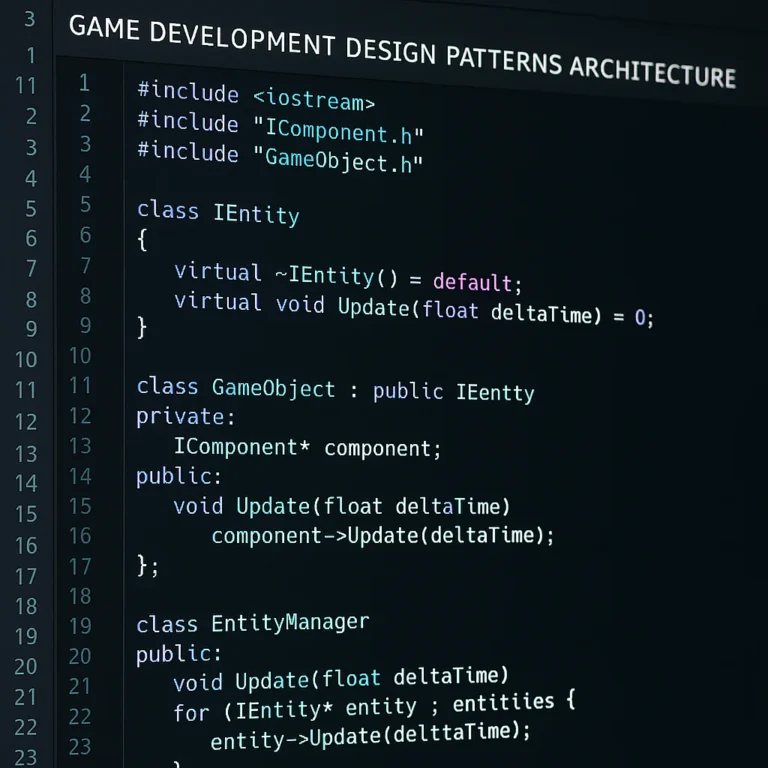
- Profile First: Never guess where the lag is; use tools like the Unity Profiler to identify bottlenecks before applying architectural changes.
Table of Contents
- ⚡️ Quick Tips and Facts
- 📜 From Arcade Cabinets to Mobile Chips: A Brief History of Game Optimization
- 🧠 Why Your Mobile Game Lags: The Hidden Cost of Bad Architecture
- 🏗️ The Blueprint: How Design Patterns Define Mobile Game Performance
- 🚀 Top 10 Design Patterns That Supercharge Mobile Game Speed and Efficiency
- 1. The Object Pool Pattern: Stop Creating and Destroying Like a Maniac
- 2. The Flyweight Pattern: Squezing Every Byte of Memory
- 3. The Command Pattern: Decoupling Input for Smooth Frame Rates
- 4. The State Pattern: Managing Complex Game Logic Without the Spaghetti
- 5. The Observer Pattern: Efficient Event Handling for UI and Systems
- 6. The Strategy Pattern: Swapping Algorithms on the Fly for Better FPS
- 7. The Singleton Pattern (Used Wisely): Global Access Without the Global Mess
- 8. The Factory Pattern: Streamlining Asset Instantiation and Loading
- 9. The Component Pattern: Building Flexible Entities for Unity and Unreal
- 10. The Decorator Pattern: Adding Features Without Re-compiling the Core
- ⚖️ At What Cost? Weighing Memory Overhead vs. CPU Cycles
- 🔗 The Art of Decoupling: How Loose Coupling Saves Your Frame Rate
- 🎮 Real-World Case Studies: How Top Studios Like Supercell and King Use Patterns
- 🛠️ Common Pitfalls: When Design Patterns Actually Hurt Performance
- 🔍 Profiling and Debuging: Finding the Bottlenecks Before They Crash Your Game
- 🤔 Striking the Balance: Simplicity vs. Scalability in Mobile Development
- 🚦 Get On With It, Already: A Practical Roadmap for Implementation
- 🏆 Conclusion
- 🔗 Recommended Links
- ❓ FAQ
- 📚 Reference Links
⚡️ Quick Tips and Facts
Before we dive into the nitty-gritty of code and CPU cycles, let’s hit the pause button and grab a few golden nugets of wisdom. If you’re in a rush, here’s the cheat sheet for optimizing mobile game performance without losing your mind:
- Garbage Collection is the Silent Killer: In languages like C# (Unity) or Java (Android), creating and destroying objects constantly triggers the Garbage Collector (GC). This causes “hitches” or frame drops. Object Pooling is your best friend here.
- Data Locality Matters More Than You Think: Modern CPUs love contiguous blocks of memory. If your game objects are scattered all over RAM, the CPU has to do a lot of “fetching,” slowing everything down. This is why Data-Oriented Design (DOD) is gaining massive traction.
- Decoupling isn’t Free: While patterns like the Observer or Command patterns make your code flexible and easier to change, they add a tiny bit of overhead (indirection). On a high-end PC, you won’t notice. On a budget Android phone? You might.
- The 256 Limit Myth: You don’t always need complex patterns. Sometimes, hard-coding a limit (e.g., “max 64 enemies”) and using a simple array is faster than a dynamic list. Simplicity is often the ultimate optimization.
- Profile First, Optimize Second: Never guess where the lag is. Use tools like the Unity Profiler or Android Studio Profiler to find the actual bottleneck before rewriting your entire architecture.
For a deeper dive into the philosophy behind these choices, check out our guide on coding design patterns at Stack Interface™.
📜 From Arcade Cabinets to Mobile Chips: A Brief History of Game Optimization

Remember the golden age of arcades? You’d drop a quarter into a cabinet, and Pac-Man would run at a buttery smooth 60 frames per second (FPS) on hardware that had less memory than a modern smartwatch. How? Hard-coded constraints.
In the 80s and 90s, developers didn’t have the luxury of “design patterns” in the modern sense. They had assembly language and bitwise operations. If you wanted a sprite to move, you didn’t call a Sprite.Move() method; you manipulated memory addresses directly. The “pattern” was: Assume the worst-case scenario and optimize for it.
Fast forward to the 20s. The iPhone arrived. Suddenly, we had powerful CPUs, but also complex operating systems (iOS, Android) managing memory for us. The industry shifted toward Object-Oriented Programming (OP). We started building massive inheritance hierarchies. We loved the Singleton pattern because it was easy to access global game state. We used the Factory pattern to spawn enemies.
But here’s the twist: OP patterns often introduce overhead. Virtual function calls, heap allocations, and pointer chasing became the norm. As mobile devices became more powerful, games got more complex, and the “hitch” problem emerged.
Enter the modern era. We are seeing a pendulum swing back. While OP is still king for maintainability, the most performant mobile games today are increasingly adopting Data-Oriented Design (DOD) and Entity Component Systems (ECS). As noted in High Performance Unity Game Development by Nitzan Wilnai, DOD “avoids design patterns and subroutines” in favor of pure atomic functions and arrays to squeeze every drop of performance out of the hardware Manning Publications.
The history of game optimization is a story of balancing flexibility (making the game fun and easy to change) with rigidity (making the game run fast).
🧠 Why Your Mobile Game Lags: The Hidden Cost of Bad Architecture
You’ve built a beautiful game. The art is stunning, the music is catchy, but when you hit the “Start Game” button on a mid-range Android device, the frame rate drops from 60 to 15. What happened?
It’s rarely the graphics. It’s the architecture.
The “Spaghetti Code” Trap
When developers rush to meet a deadline, they often write “spaghetti code”—logic that is tightly coupled. Imagine a Player class that directly calls the Enemy class, which then calls the AudioManager, which then calls the UIManager.
If you want to change how the player jumps, you might accidentally break the enemy AI or the sound effects. This is the ripple effect. To fix it, you end up adding if statements everywhere, making the code harder to read and slower to execute.
The Memory Fragmentation Nightmare
In mobile development, memory is precious. If your architecture relies heavily on new and delete (or Instantiate and Destroy in Unity) every frame, you create memory fragmentation. The Garbage Collector has to run frequently to clean up, causing those dreaded “stutters.”
“Good design means that when I make a change, it’s as if the entire program was crafted in anticipation of it.” — Game Programming Patterns
This quote from Bob Nystrom highlights a crucial point: Good architecture reduces cognitive load. If your code is decoupled, you can optimize the rendering loop without worrying about breaking the physics engine.
The Cost of Abstraction
Every design pattern you introduce adds a layer of abstraction.
- Virtual Dispatch: Instead of calling a function directly, the CPU has to look up the function pointer in a table.
- Indirection: Instead of accessing data directly, you might access it through a pointer or a reference.
On a desktop PC, this cost is negligible. On a mobile chip with limited cache and thermal throttling, these micro-delays add up to milliseconds. And in gaming, 16 milliseconds is the difference between 60 FPS and 30 FPS.
🏗️ The Blueprint: How Design Patterns Define Mobile Game Performance
So, how do we fix this? We don’t throw away patterns; we strategically apply them.
Design patterns are like blueprints. They solve common problems. But in mobile games, the problem isn’t just “how do I organize my code?” It’s “how do I organize my code without killing the frame rate?”
The Three Pillars of Performance Patterns
- Memory Management: Patterns that reduce allocation and dealocation (e.g., Object Pooling).
- CPU Efficiency: Patterns that minimize branching and improve cache locality (e.g., Component-based architecture).
- Decoupling: Patterns that allow independent optimization of systems (e.g., Command, Observer).
Let’s look at how these patterns interact with the CPU Cache. Modern CPUs have small, fast caches (L1, L2, L3). If your data is scattered in memory (because you used a linked list of objects), the CPU has to wait for data to be fetched from RAM. This is a cache miss.
Design patterns like the Component Pattern encourage storing data in contiguous arrays (Structure of Arrays vs. Array of Structures), which drastically reduces cache misses.
🚀 Top 10 Design Patterns That Supercharge Mobile Game Speed and Efficiency
Here is the meat of the article. We’ve ranked these patterns based on their impact on mobile performance, from the absolute must-haves to the situational heroes.
1. The Object Pool Pattern: Stop Creating and Destroying Like a Maniac
The Problem: In a typical shooter, you might spawn 50 bullets per second. If you new a bullet and delete it every time, you are hammering the memory allocator. The Garbage Collector will run, pause your game, and cause a stutter.
The Solution: The Object Pool pattern pre-allocates a fixed number of objects (e.g., 10 bullets) at the start of the game. When you need a bullet, you grab one from the pool. When it’s done, you “disable” it and return it to the pool.
- Performance Win: Zero allocation during gameplay. No GC spikes.
- Best For: Projectiles, particles, enemies, UI elements.
- Trade-off: You need to manage the pool size carefully. If you run out, you have to decide whether to expand (costly) or recycle the oldest one.
Pro Tip: In Unity, use
ObjectPool<T>or write a custom one. Never useInstantiateinside theUpdateloop for high-frequency objects.
2. The Flyweight Pattern: Squezing Every Byte of Memory
The Problem: Imagine a game with 1,0 trees. Each tree has a position, rotation, and a reference to a “TreeModel” (mesh, texture). If you create 1,0 separate objects, you are storing the mesh reference 1,0 times. That’s wasted memory.
The Solution: The Flyweight pattern separates intrinsic state (data that is the same for all objects, like the mesh) from extrinsic state (data that changes, like position). You store the mesh once and share it among all 1,0 trees.
- Performance Win: Massive reduction in memory usage.
- Best For: Tile maps, particle systems, large crowds of identical enemies.
- Trade-off: Slightly more complex code to manage the shared state.
3. The Command Pattern: Decoupling Input for Smooth Frame Rates
The Problem: Your input handling logic is tightly coupled to your game logic. When you press “Jump,” the InputManager directly calls player.Jump(). If you want to add a “replay” feature or a “network prediction” system, you have to rewrite everything.
The Solution: The Command pattern encapsulates a request as an object. When you press “Jump,” you create a JumpCommand object and add it to a queue. The game loop processes the queue.
- Performance Win: Allows for input buffering and network lag compensation without complex logic in the main loop. It also makes it easier to batch inputs.
- Best For: Input systems, undo/redo features, AI behavior trees.
- Trade-off: Creating command objects can trigger GC if not pooled. Always pool your commands!
4. The State Pattern: Managing Complex Game Logic Without the Spaghetti
The Problem: You have a character with 50 different states (Idle, Run, Jump, Attack, Hit, Die…). Your Update function is a nightmare of if (state == Idle) ... else if (state == Run) .... This is slow to execute and hard to maintain.
The Solution: The State pattern encapsulates each state into its own class. The character delegates the Update call to the current state object.
- Performance Win: Reduces branching (if/else) in the main loop. The CPU can predict the branch better.
- Best For: Character controllers, AI behavior, UI screens.
- Trade-off: Can lead to a lot of small classes. Use State Machines carefully to avoid excessive indirection.
5. The Observer Pattern: Efficient Event Handling for UI and Systems
The Problem: You need to update the UI when the player’s health changes. You could poll the health value every frame (wasteful) or have the health class call the UI class directly (tightly coupled).
The Solution: The Observer pattern (or Event System) allows the health class to “broadcast” a HealthChanged event. Any system interested (UI, Audio, Achievement) can “subscribe” to it.
- Performance Win: Decouples systems. You can disable the UI system without breaking the health logic.
- Best For: UI updates, achievement triggers, audio cues.
- Trade-off: Over-subscription can be slow. If 1,0 objects subscribe to an event, broadcasting it takes time. Use Event Channels or Job Systems to optimize.
6. The Strategy Pattern: Swapping Algorithms on the Fly for Better FPS
The Problem: You have different rendering algorithms for different devices (Low, Medium, High). You have a massive if (device == Low) ... else if (device == Medium) ... block in your render loop.
The Solution: The Strategy pattern allows you to swap the rendering algorithm at runtime without changing the core logic.
- Performance Win: Clean code that is easier to optimize. You can use a highly optimized, specialized algorithm for mobile without cluttering the codebase.
- Best For: Rendering pipelines, AI difficulty levels, physics solvers.
- Trade-off: Virtual function calls for the strategy switch.
7. The Singleton Pattern (Used Wisely): Global Access Without the Global Mess
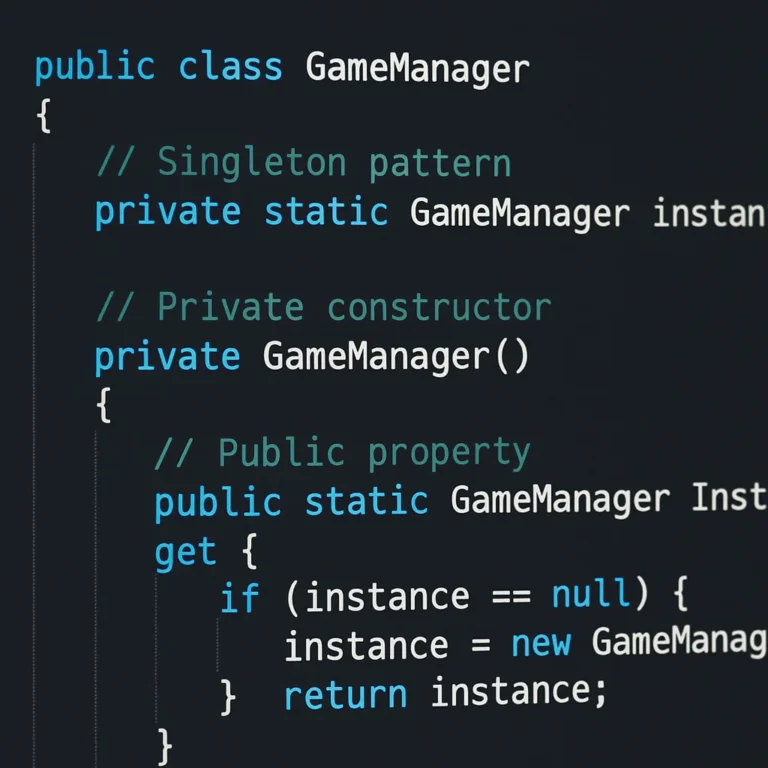
The Problem: You need access to the GameManager from everywhere. You make it a global variable. Now you can’t test it, and you can’t have two game managers (e.g., for a split-screen mode).
The Solution: The Singleton pattern ensures only one instance exists. But wait! In mobile games, Singletons are dangerous because they are hard to mock and can cause memory leaks.
- Performance Win: Fast global access (no need to pass references).
- Best For: Audio managers, save systems (with caution).
- Trade-off: Tight coupling. Use Dependency Injection instead if possible. If you must use a Singleton, make it lazy-loaded and thread-safe.
8. The Factory Pattern: Streamlining Asset Instantiation and Loading
The Problem: You have different types of enemies, and each has a different loading logic. You have if (type == Goblin) ... else if (type == Orc) ... everywhere.
The Solution: The Factory pattern encapsulates the creation logic. You ask the factory for an enemy, and it returns the correct object.
- Performance Win: Centralizes asset loading. You can add asynchronous loading logic in one place.
- Best For: Spawning enemies, creating UI elements, loading levels.
- Trade-off: Can become a “God Object” if not managed well.
9. The Component Pattern: Building Flexible Entities for Unity and Unreal
The Problem: You have a Player class that inherits from Character, which inherits from Entity. You want to add a “Flying” ability. Do you create a FlyingCharacter class? Now you have a hierarchy explosion.
The Solution: The Component pattern (used in ECS and Unity’s MonoBehaviour system) breaks entities into small, reusable components (e.g., HealthComponent, MovementComponent, RenderComponent).
- Performance Win: Data locality. You can store all
MovementComponentdata in a contiguous array, making it incredibly fast to iterate over. This is the foundation of Data-Oriented Design. - Best For: Complex game entities, moding support.
- Trade-off: Can be verbose. Requires a good understanding of data structures.
10. The Decorator Pattern: Adding Features Without Re-compiling the Core
The Problem: You want to add a “Shield” to a player. Do you create a ShieldedPlayer class? What if you want a ShieldedFlyingPlayer?
The Solution: The Decorator pattern wraps the player object with a “Shield” object that adds the shield logic.
- Performance Win: Dynamic feature addition without inheritance hell.
- Best For: Power-ups, equipment systems, UI layers.
- Trade-off: Can create deep object chains, which might slow down access.
⚖️ At What Cost? Weighing Memory Overhead vs. CPU Cycles
It’s time to address the elephant in the room: Every pattern has a cost.
| Pattern | Memory Overhead | CPU Overhead | Best Use Case |
|---|---|---|---|
| Object Pool | Low (Pre-allocated) | Low (No allocation) | High-frequency objects |
| Flyweight | Very Low (Shared data) | Low (Indirection) | Large numbers of similar objects |
| Command | Medium (Object creation) | Medium (Queue processing) | Input, Undo/Redo |
| State | Low | Low (Branch prediction) | Complex logic flows |
| Observer | Low | Medium (Event dispatch) | Decoupled systems |
| Singleton | Low | Very Low | Global managers (Use with care) |
| Component | Medium (Data arrays) | Very Low (Cache friendly) | Entity systems, ECS |
The Trade-off:
- Flexibility vs. Speed: The more flexible your code (using patterns like Observer or Strategy), the more indirection you introduce. Indirection means more CPU cycles.
- Memory vs. CPU: The Flyweight pattern saves memory but might increase CPU usage due to pointer chasing. The Object Pool saves CPU cycles but uses more memory upfront.
The Golden Rule: Profile first. Don’t optimize until you know where the bottleneck is. If your game is memory-bound, use Flyweight. If it’s CPU-bound, use Object Pooling and Component patterns.
🔗 The Art of Decoupling: How Loose Coupling Saves Your Frame Rate
Why does decoupling matter for performance?
Imagine a monolithic GameLoop that handles physics, rendering, input, and AI all in one giant function. If you want to optimize the physics engine, you have to be careful not to break the rendering code. This is the ripple effect.
With lose coupling, you can isolate the physics engine. You can rewrite it to use a highly optimized C++ library without touching the rendering code. You can even run the physics on a separate thread!
How to Decouple:
- Interfaces: Define what a system does, not how it does it.
- Events: Use the Observer pattern to communicate between systems.
- Dependency Injection: Pass dependencies into classes rather than creating them inside.
“Good design means that when I make a change, it’s as if the entire program was crafted in anticipation of it.” — Game Programming Patterns
By decoupling, you reduce the cognitive load on the developer. You can optimize one part of the game without fearing that you’ll break the whole thing. This leads to faster iteration and better performance in the long run.
🎮 Real-World Case Studies: How Top Studios Like Supercell and King Use Patterns
Let’s look at how the giants do it.
Supercell (Clash of Clans, Brawl Stars)
Supercell is known for its Component-based architecture. They use a heavy reliance on Data-Oriented Design principles. Their game logic is separated from the rendering logic. This allows them to run the same game logic on iOS, Android, and even PC with minimal changes.
- Pattern Used: Component Pattern and Object Pooling.
- Result: Smooth 60 FPS on a wide range of devices, from old iPhones to low-end Androids.
King (Candy Crush Saga)
King’s games are puzzle-based, meaning they have a lot of state changes and UI updates. They rely heavily on the Observer pattern to handle UI updates. When a match is made, the game logic broadcasts an event, and the UI, sound, and particle systems react independently.
- Pattern Used: Observer Pattern and State Pattern.
- Result: A highly responsive UI that doesn’t lag even with complex animations.
Unity Technologies (ECS)
Unity has embraced Data-Oriented Design with their Entity Component System (ECS). This is a shift away from traditional OP patterns. In ECS, data is stored in contiguous arrays, and logic is separated into systems that operate on that data.
- Pattern Used: Component Pattern (ECS style) and Strategy Pattern (for systems).
- Result: Massive performance gains, especially for games with thousands of entities.
🛠️ Common Pitfalls: When Design Patterns Actually Hurt Performance
Not all patterns are created equal. Here are the traps to avoid:
- Over-Engineering: Using the Singleton pattern for everything. This creates hidden dependencies and makes testing impossible.
- Premature Optimization: Trying to optimize before you have a working game. As the saying goes, “It’s easier to make a fun game fast than it is to make a fast game fun.”
- Ignoring the Garbage Collector: Using the Command or Observer patterns without pooling your objects. This leads to frequent GC spikes.
- Deep Inheritance: Using the State pattern with deep inheritance hierarchies. This can lead to slow virtual dispatch.
- Too Many Events: Using the Observer pattern for everything. If you have 1,0 listeners for a single event, the broadcast will be slow.
The Fix: Keep it simple. Use patterns only when they solve a specific problem. If a simple if statement works, use it.
🔍 Profiling and Debuging: Finding the Bottlenecks Before They Crash Your Game
You can’t fix what you can’t measure. Here’s how to profile your game:
Unity Profiler
- CPU Usage: Look for spikes in
Update,FixedUpdate, or specific systems. - Memory: Check for “GC Alloc” spikes. If you see high allocations every frame, you need Object Pooling.
- Rendering: Check for “SetPass Calls” and “Batches”. High numbers mean your rendering is inefficient.
Android Studio Profiler
- Memory: Monitor heap usage and GC events.
- CPU: Trace method calls to find slow functions.
- Energy: Check battery usage to see if your game is draining the battery too fast.
Xcode Instruments (iOS)
- Time Profiler: Find the most time-consuming functions.
- Allocations: Track memory usage over time.
- Energy Log: See how your game affects battery life.
Step-by-Step Profiling:
- Run the game on the target device.
- Identify the bottleneck: Is it CPU, Memory, or Rendering?
- Apply the pattern: If it’s memory, use Object Pooling. If it’s CPU, use Component Pattern.
- Re-profile: Did it help? If not, try a different approach.
🤔 Striking the Balance: Simplicity vs. Scalability in Mobile Development
The eternal struggle: Simplicity vs. Scalability.
- Simplicity: Simple code is fast. It’s easy to understand. It’s easy to debug. But it might not scale well if you need to add new features.
- Scalability: Complex patterns (like ECS or Strategy) make it easy to add new features. But they add overhead and complexity.
The Solution: Iterative Refinement.
- Prototype: Write simple, “slapdash” code. Get the game fun.
- Identify: Find the bottlenecks.
- Refactor: Apply the right patterns to the problematic areas.
- Repeat: Don’t try to optimize everything at once.
“A good solution isn’t an accretion of code, it’s a distillation of it.” — Game Programming Patterns
Start simple. Only add complexity when you need it.
🚦 Get On With It, Already: A Practical Roadmap for Implementation
Ready to optimize your game? Here’s your roadmap:
- Audit Your Code: Look for
newanddeletecalls in yourUpdateloop. - Implement Object Pooling: Start with your most frequent objects (bulets, particles).
- Decouple Systems: Use the Observer pattern to separate UI, Audio, and Logic.
- Profile: Use the Unity Profiler or Android Studio Profiler to find the next bottleneck.
- Refactor: Apply the Component pattern or Flyweight pattern where needed.
- Test: Run the game on a low-end device. Does it still run smoothly?
- Repeat: Optimization is a continuous process.
Don’t forget: The best optimization is the one you don’t have to do. Write clean, simple code from the start.
🏆 Conclusion

Optimizing mobile game performance is a delicate dance between flexibility and rigidity. Design patterns are powerful tools, but they are not magic wands. They come with costs in memory and CPU cycles.
The key takeaway? Profile first, optimize second. Use patterns like Object Pooling and Component to solve specific performance problems. Don’t over-enginer your code. Keep it simple, and only add complexity when you need it.
Remember the words of Nitzan Wilnai in High Performance Unity Game Development: “Data-oriented design takes advantage of modern CPUs to upgrade game performance, easily outpacing traditional object-oriented programming.” While DOD is powerful, traditional patterns still have their place. The best developers know when to use which tool.
So, go forth and optimize! Your players will thank you for the smooth 60 FPS experience.
🔗 Recommended Links
If you’re ready to take your game development skills to the next level, here are some essential resources:
- Books:
High Performance Unity Game Development by Nitzan Wilnai: A must-read for anyone serious about mobile optimization. Check Price on Amazon
Game Programming Patterns by Robert Nystrom: The bible of design patterns in games. Check Price on Amazon - Tools:
Unity Profiler: Built-in tool for Unity developers.
Android Studio Profiler: Essential for Android development.
Xcode Instruments: The go-to tool for iOS optimization. - Courses:
- Unity Learn: Official Unity courses on optimization.
- Udemy – Unity Game Optimization: A comprehensive guide to performance tuning.
❓ FAQ

Which design patterns reduce memory usage in mobile games?
The Flyweight pattern is the champion of memory reduction. By sharing common data (like textures or meshes) among multiple objects, you drastically reduce the memory footprint. The Object Pool pattern also helps by preventing frequent memory allocations and dealocations, which can lead to fragmentation.
Read more about “🎮 8 Real-World Design Patterns Powering Your Favorite Games (2026)”
How does the Object Pool pattern improve frame rates in Unity?
In Unity, Instantiate and Destroy are expensive operations that trigger the Garbage Collector. The Object Pool pattern pre-allocates objects and reuses them. This eliminates the need for allocation during gameplay, preventing GC spikes and ensuring a consistent frame rate.
Can the State pattern optimize battery life in Android games?
Indirectly, yes. The State pattern helps organize complex logic, making it easier to optimize specific states (e.g., pausing the physics engine when the game is in a “Menu” state). By reducing unnecessary calculations in idle states, you can save battery life.
Read more about “🤖 AI in Mobile Game Dev: 10 Tools & The Agentic Revolution (2026)”
What are the best performance patterns for 2D mobile game engines?
For 2D games, the Component pattern (or ECS) is highly effective for managing large numbers of sprites. The Flyweight pattern is excellent for tile maps. The Object Pool pattern is essential for managing projectiles and particles.
Read more about “🏗️ Adapter & Decorator: The Secret to Flexible App & Game Architecture (2026)”
How does the Flyweight pattern handle large numbers of game objects?
The Flyweight pattern separates intrinsic state (shared data) from extrinsic state (unique data). For example, in a game with 1,0 trees, the tree model (mesh, texture) is stored once (intrinsic), while the position and rotation are stored for each tree (extrinsic). This reduces memory usage significantly.
Read more about “🚀 What Are the Coding Patterns? 15 Essential Blueprints for 2026”
Does the Command pattern introduce latency in real-time mobile games?
The Command pattern can introduce a tiny bit of latency due to the indirection of queuing commands. However, this is usually negligible if implemented correctly. To minimize latency, use object pooling for command objects and process the command queue efficiently.
Read more about “🎮 7 Coding Patterns That Master Multiplayer Game Dev (2026)”
Which architectural patterns prevent garbage collection spikes in iOS games?
The Object Pool pattern is the primary defense against GC spikes. Additionally, using Value Types (structs) instead of Reference Types (classes) where possible can reduce heap allocations. The Component pattern (ECS) also helps by storing data in contiguous arrays, reducing the need for object creation.
Read more about “🛠️ 12 Patterns That Fix Game Code (2026 Guide)”
📚 Reference Links
- Game Programming Patterns: https://gameprogrammingpatterns.com/
- High Performance Unity Game Development (Manning): https://www.manning.com/books/high-performance-unity-game-development
- Unity Documentation – Profiler: https://docs.unity3d.com/Manual/Profiler.html
- Android Developer – Performance: https://developer.android.com/topic/performance
- Apple Developer – Instruments: https://developer.apple.com/tutorials/instruments
- Supercell Blog: https://supercell.com/en/news/
- King Developer Blog: https://careers.king.com/us/en/technology-development-page