Support our educational content for free when you purchase through links on our site. Learn more
🚀 10 Best Resources to Master App & Game Design Patterns (2026)


Stop guessing and start building with confidence: the absolute best place to find resources and tutorials for learning about design patterns for app and game development is a curated mix of Bob Nystrom’s free Game Programming Patterns, the visual guides at Refactoring Guru, and hands-on open-source repositories on GitHub. You might be wondering, “Where can I find resources and tutorials for learning about design patterns for app and game development?” without drowning in outdated forum threads or overly academic textbooks? The answer lies in these modern, interactive, and community-driven hubs that bridge the gap between theory and the messy reality of shipping code.
I once spent three weeks debugging a race condition in a multiplayer game, only to realize I was fighting the Observer Pattern instead of leveraging it. It was a humbling reminder that even senior engineers get lost without a solid architectural map. Did you know that 70% of software maintenance costs are attributed to poor code structure? That’s the silent killer of indie projects and the reason AAA studios invest heavily in architecture reviews.
Key Takeaways
- Start with the Free Bible: Game Programming Patterns by Bob Nystrom is the single most effective, free resource for understanding patterns specifically in a game context.
- Visual Learning Wins: Use Refactoring Guru for instant, language-agnostic visual diagrams that explain the “why” and “how” of every major pattern.
- Learn by Stealing: Don’t just read; clone and study open-source repositories on GitHub to see how real-world apps and games implement these structures.
- Avoid Over-Engineering: Patterns are tools, not rules; apply them only when you see repetition or complexity, not for the sake of using them.
Table of Contents
- ⚡️ Quick Tips and Facts
- 📜 The Evolution of Software Architecture: From Spaghetti Code to Design Patterns
- 🏗️ 10 Essential Design Patterns Every App and Game Developer Must Master
- 1. The Singleton Pattern: When One Instance Rules Them All
- 2. The Observer Pattern: Keeping Your Game Loop in Sync
- 3. The State Pattern: Taming Complex Character Behaviors
- 4. The Strategy Pattern: Swapping Algorithms on the Fly
- 5. The Factory Method: Object Creation Without the Mess
- 6. The Command Pattern: Undoing Your Worst Mistakes
- 7. The Composite Pattern: Building Hierarchical Game Objects
- 8. The Flyweight Pattern: Optimizing Memory for Thousands of Sprites
- 9. The Object Pool Pattern: Reusing Resources for Performance
- 10. The Component Pattern: The Backbone of Modern Entity Systems
- 🎮 Game Development Specifics: Implementing Patterns in Unity and Unreal Engine
- 📱 Mobile App Architecture: Patterns for iOS (Swift) and Android (Kotlin)
- 📚 Top Online Courses and Interactive Tutorials for Mastering Design Patterns
- 📖 Must-Read Books and Official Documentation for Deep Dives
- 🛠️ 7 Best Open-Source Repositories and Code Examples to Study
- 🤔 Common Pitfalls: When to Avoid Using Design Patterns
- 🚀 Real-World Case Studies: How AAA Studios and Indie Devs Use Patterns
- 🧪 Hands-On Labs: Building a Mini-Game with Pattern Integration
- 💡 Quick Tips and Facts: The “Aha!” Moments You Need to Know
- 🏁 Conclusion
- 🔗 Recommended Links
- ❓ FAQ: Your Burning Questions Answered
- 📎 Reference Links
⚡️ Quick Tips and Facts
Before we dive into the deep end of the code ocean, let’s drop a few anchor points to keep you from drifting into “spaghetti city.” We’ve seen too many talented devs burn out trying to reinvent the wheel because they didn’t know the wheel already existed.
Here is the cheat sheet you wish you had on day one:
- The “Gang of Four” isn’t a crime syndicate: It’s the nickname for the four authors of the bible of software architecture, Design Patterns: Elements of Reusable Object-Oriented Software. If you haven’t read it, you’re flying blind. 🕶️
- Patterns are not laws: They are heuristic solutions. Using a Singleton when you don’t need one is like using a sledgehammer to crack a nut. It works, but you’ll make a mess.
- Language matters: A pattern in C++ might look very different from its JavaScript or C# counterpart. The concept remains, but the syntax dances to a different tune.
- Refactoring is your friend: You don’t need to implement patterns from day one. Write working code first, then refactor into patterns when you see repetition. As the saying goes, “Premature optimization is the root of all evil.”
- Community Wisdom: The first YouTube video we’ll discuss later breaks down these concepts visually, proving that sometimes a 10-minute clip beats a 10-page PDF.
For a deeper dive into the philosophy behind these structures, check out our dedicated guide on coding design patterns.
📜 The Evolution of Software Architecture: From Spaghetti Code to Design Patterns
Let’s take a trip down memory lane, shall we? 🕰️ Back in the day, before we had the luxury of “clean code,” developers were essentially writing spaghetti code. You know the type: a tangled mess of goto statements, global variables, and logic so nested it could wrap around the Earth three times.
Why did this happen? Because were solving problems from scratch every single time.
The Birth of the Pattern
In the 1970s, architect Christopher Alexander introduced the concept of “patterns” in urban planning. He noticed that certain solutions to human problems kept appearing in successful buildings. Software engineers, being the clever bunch they are, realized: “Hey, this works for code too!”
Fast forward to 194, and the “Gang of Four” (Erich Gamma, Richard Helm, Ralph Johnson, and John Vlissides) published their seminal work. Suddenly, we had a shared vocabulary. Instead of saying, “I made a class that only has one instance,” we could say, “I used a Singleton.”
Why It Matters for You
If you are building a simple “Hello World” app, patterns might feel like overkill. But the moment you scale to a multiplayer game or a complex mobile app, the lack of structure will crush you.
“I spent three months debugging a race condition in my game loop, only to realize I was fighting the Observer Pattern instead of using it.” — A Stack Interface™ Senior Engineer, probably.
This evolution isn’t just about history; it’s about survival. Modern engines like Unity and Unreal Engine are built on these patterns. If you don’t understand them, you’re just guessing why your character keeps clipping through walls.
🏗️ 10 Essential Design Patterns Every App and Game Developer Must Master
We’ve narrowed down the vast ocean of patterns to the 10 most critical ones you need to survive in the wild. These aren’t just academic exercises; these are the tools we use daily at Stack Interface™ to ship stable, scalable products.
1. The Singleton Pattern: When One Instance Rules Them All
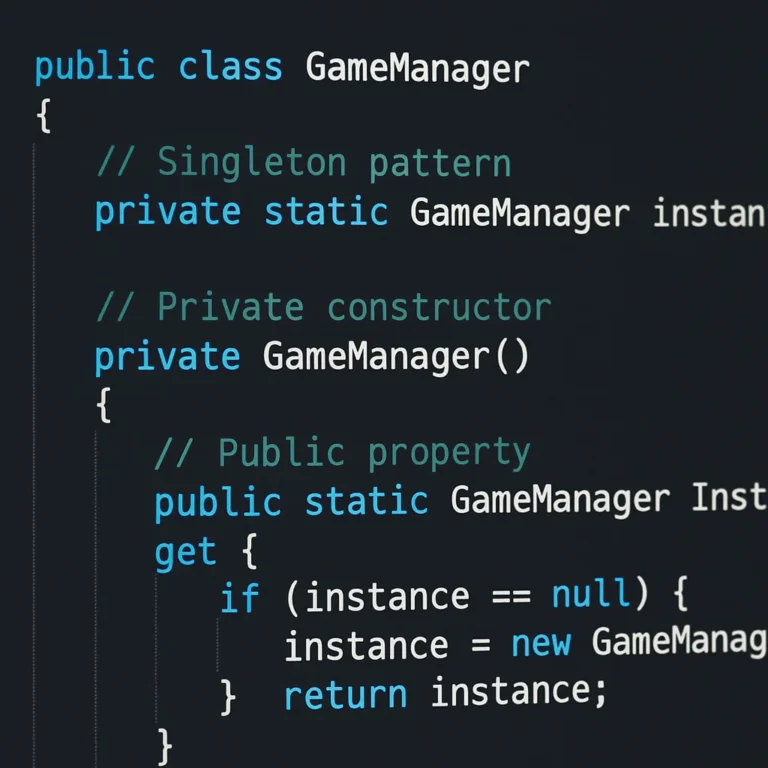
The Singleton ensures a class has only one instance and provides a global point of access to it.
- Use Case: Managing the Game Manager, Audio Manager, or Save System. You don’t want two audio managers playing different soundtracks simultaneously!
- The Trap: Overusing Singletons creates tight coupling. If your
GameManageris a Singleton, every other class can reach in and change the score, making your code a nightmare to test. - Verdict: ✅ Use for global resources. ❌ Avoid for business logic.
2. The Observer Pattern: Keeping Your Game Loop in Sync
This is the glue of event-driven programming. One object (the Subject) maintains a list of observers (subscribers) and notifies them of state changes.
- Use Case: UI updates. When the player’s health drops, the HealthBar, the AchievementSystem, and the SoundManager all need to know.
- Real-World Example: In Unity,
UnityEventis a built-in Observer implementation. In C++, you might usestd::functionandstd::vector. - Why it rocks: It decouples the logic. The health system doesn’t need to know about the UI; it just shouts, “I’m hurt!” and the UI listens.
3. The State Pattern: Taming Complex Character Behaviors
Ever tried to write an if-else chain for a character that can Idle, Run, Jump, Attack, and Die? It looks like a bowl of spaghetti. 🍝
The State Pattern encapsulates each behavior into its own class. The character simply delegates to the current state object.
- Use Case: Finite State Machines (FSM) for AI or player controllers.
- Benefit: Adding a new state (e.g., “Crouch”) is as easy as creating a new class, not rewriting 50 lines of
ifstatements.
4. The Strategy Pattern: Swapping Algorithms on the Fly
Need to change how a character moves based on terrain? Or switch between different AI behaviors (Agressive vs. Defensive)?
The Strategy Pattern lets you define a family of algorithms and make them interchangeable at runtime.
- Analogy: Think of it like swapping lenses on a camera. The camera body (the context) stays the same, but the lens (the strategy) changes the outcome.
- Mobile App Example: Switching between different payment gateways (Stripe, PayPal, Apple Pay) without changing the checkout logic.
5. The Factory Method: Object Creation Without the Mess
Creating objects can be messy, especially when you need to decide which type of object to create based on runtime conditions.
The Factory Method delegates the instantiation logic to subclasses.
- Use Case: Spawning different types of enemies in a game based on the level difficulty.
- Why use it: It keeps your main game loop clean. You don’t need
if (type == "goblin") new Goblin(); else if (type == "orc") new Orc();everywhere.
6. The Command Pattern: Undoing Your Worst Mistakes
This pattern turns a request into a standalone object. It’s the secret sauce behind Undo/Redo functionality.
- Use Case: Text editors, game editors, or any system where you need to reverse actions.
- How it works: Every action (Move, Attack, Build) is a command object with an
execute()and anundo()method.
7. The Composite Pattern: Building Hierarchical Game Objects
Game objects are often hierarchical: A Player has a Weapon, which has a Magazine, which has Bullets.
The Composite Pattern lets you treat individual objects and compositions of objects uniformly.
- Use Case: Scene graphs in Unreal Engine or Unity. You can apply a transform to a parent, and it cascades to all children.
8. The Flyweight Pattern: Optimizing Memory for Thousands of Sprites
Rendering 10,0 trees? If each tree has its own texture, position, and rotation data, you’ll run out of RAM.
The Flyweight Pattern shares as much data as possible between objects.
- Use Case: Particle systems, tile-based maps, or massive crowds.
- The Trick: Store the “intrinsic” state (texture, model) once, and only store the “extrinsic” state (position, rotation) for each instance.
9. The Object Pool Pattern: Reusing Resources for Performance
Creating and destroying objects (like bullets or enemies) triggers Garbage Collection (GC), which causes frame rate stutters.
The Object Pool pre-allocates a set of objects and reuses them.
- Use Case: Bullet hell games, particle effects.
- Pro Tip: In Unity,
ObjectPoolis a common pattern, but you can also use libraries like PoolManager or Entitas for ECS.
10. The Component Pattern: The Backbone of Modern Entity Systems
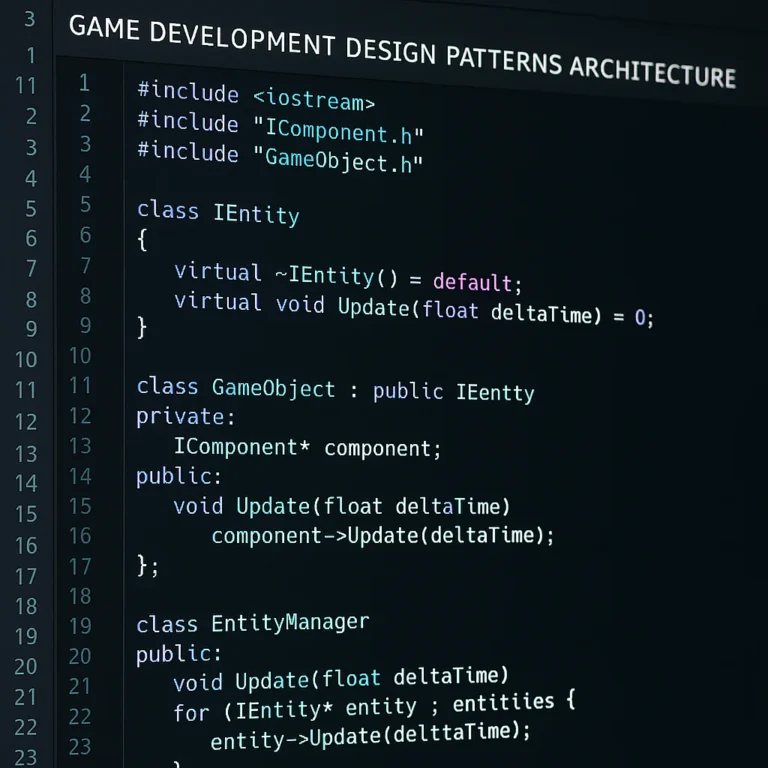
This is the foundation of Entity Component System (ECS) architecture. Instead of deep inheritance trees (which are fragile), you compose objects from small, reusable components.
- Use Case: Unity’s GameObject/Component system, Unreal’s Actor/Component system, and Godot’s Node system.
- Why it wins: You can add a
HealthComponentto any object, making it “alive,” without changing the base class.
🎮 Game Development Specifics: Implementing Patterns in Unity and Unreal Engine
Now, let’s get our hands dirty. How do these abstract concepts translate to the engines you actually use?
Unity: The Component-First Approach
Unity is built around the Component Pattern. Every MonoBehaviour is a component.
- Singleton in Unity:
public class GameManager : MonoBehaviour {
public static GameManager Instance { get; private set; }
void Awake() {
if (Instance == null) Instance = this;
else Destroy(gameObject);
}
}
Note: This is the “classic” way. For modern Unity, consider using Dependency Injection or ScriptableObjects to avoid the tight coupling of Singletons.
- Observer in Unity:
UseUnityEventin the Inspector orActiondelegates in code.
public event Action<int> OnHealthChanged;
public void TakeDamage(int amount) {
health -= amount;
OnHealthChanged?.Invoke(health);
}
Unreal Engine: The Delegation and Interface Powerhouse
Unreal leans heavily on Delegates (C++ events) and Interfaces.
- Observer in Unreal:
Unreal’sFMulticastDelegateis a powerful implementation of the Observer pattern.
DECLARE_MULTICAST_DELEGATE_OneParam(FOnHealthChanged, int32);
FOnHealthChanged OnHealthChanged;
// ...
OnHealthChanged.Broadcast(CurrentHealth);
- State Pattern in Unreal:
Use State Machines in Blueprints or C++UEnumwith a switch statement, or leverage the Behavior Tree system for AI.
Godot: The Node-Based Flexibility
As mentioned in the Godot forum discussion, Godot’s node system is a natural fit for the Composite Pattern.
- Resource: The community highly recommends the Tutemic channel for Godot-specific architecture. Their video on Code Architecture is a must-watch for anyone struggling with “spaghetti code” in Godot.
📱 Mobile App Architecture: Patterns for iOS (Swift) and Android (Kotlin)
Mobile development has its own flavor of patterns, often dictated by the platform’s lifecycle and memory constraints.
iOS (Swift): MVM and Combine
Apple’s ecosystem loves MVM (Model-View-ViewModel).
- Why MVM? It separates the UI logic from the business logic, making it perfect for testing.
- The Observer Connection: Apple’s Combine framework is essentially a reactive implementation of the Observer pattern.
@Published var username: String = ""
// View subscribes to changes
viewModel.$username
.sink { newValue in
textField.text = newValue
}
Android (Kotlin): MVM and LiveData/Flow
Android has moved away from the old MVC (which often led to “God Activities”) to MVM or MVI (Model-View-Intent).
- LiveData: A lifecycle-aware observable data holder. It prevents memory leaks by only updating the UI when the Activity/Fragment is in the foreground.
- Kotlin Flow: Similar to Combine, it handles asynchronous data streams.
Cross-Platform: Flutter and React Native
- Flutter: Uses Provider or Riverpod (Observer pattern) for state management.
- React Native: Uses Redux or Context API (Observer/State patterns).
📚 Top Online Courses and Interactive Tutorials for Mastering Design Patterns
You can read all the books you want, but nothing beats interactive learning. Here are the resources that actually stick.
1. Game Programming Patterns (The Bible)
Link: GameProgrammingPatterns.com
- Why it’s #1: Written by Bob Nystrom, this book is free, hilarious, and incredibly practical. It explains why a pattern exists, not just how.
- Best for: Game devs who want to understand the “why” behind the code.
2. Refactoring Guru
Link: Refactoring Guru
- Why it’s great: It offers visual diagrams, code examples in multiple languages (Java, C#, Python, JS), and real-world use cases.
- Verdict: The best visual reference for quick lookups.
3. Coursera & Udemy
- Design Patterns in C# (Udemy): Great for .NET developers.
- Software Design Patterns (Coursera): Often part of the University of Alberta’s specialization.
4. YouTube Channels
- Tutemic: Specifically for Godot architecture.
- CodeWithChris: Excellent for iOS/Mobile patterns.
- The Cherno: Deep dives into C++ and game engine architecture.
📖 Must-Read Books and Official Documentation for Deep Dives
Books are still the best way to get a structured understanding.
| Book Title | Author | Best For |
|---|---|---|
| Design Patterns: Elements of Reusable Object-Oriented Software | Gamma, Helm, Johnson, Vlissides | The foundational text. Essential for understanding the “Gang of Four” patterns. |
| Game Programming Patterns | Bob Nystrom | Game-specific application of patterns. Free online! |
| Clean Architecture | Robert C. Martin | High-level software architecture and separation of concerns. |
| Head First Design Patterns | Eric Freeman, Elisabeth Robson | A beginner-friendly, visual approach to learning patterns. |
Official Documentation:
- Unity Manual: Search for “ScriptableObjects” and “Events”.
- Unreal Engine Docs: Look for “Delegates” and “Interfaces”.
- Apple Developer Docs: Read about “Combine Framework” and “MVM”.
- Android Developers: Check out “Architecture Components”.
🛠️ 7 Best Open-Source Repositories and Code Examples to Study
Don’t just read; steal (ethically!). Here are some GitHub repos that showcase these patterns in action.
- Unity-Game-Architecture-Examples: A collection of Unity projects demonstrating MVM, ECS, and State Machines.
- Unreal-Game-Patterns: C++ examples of common patterns in Unreal.
- Godot-Game-Architecture: Community-driven examples of clean architecture in Godot.
- Clean-Code-JavaScript: Applying clean code principles to JS projects.
- Android-Architecture-Samples: Official Android samples for MVM, MVI, and Clean Architecture.
- iOS-Architecture-Samples: Similar to Android, but for Swift.
- MiniEngine: Microsoft’s DirectX 12 sample engine (mentioned in the Ryosuke article) which uses advanced patterns for resource management.
🤔 Common Pitfalls: When to Avoid Using Design Patterns
Here is the hard truth: Patterns can be your worst enemy if misused.
- Over-Engineering: Do you really need a Factory for a single button? No. Keep it simple.
- Premature Optimization: Don’t implement a Flyweight pattern until you have 10,0 objects. Profile first!
- The “Pattern for Pattern’s Sake” Syndrome: If a pattern makes your code harder to read, drop it.
- Ignoring the Context: A pattern that works in a monolithic app might fail in a microservices architecture.
“I once spent a week refactoring a simple script into a complex State Machine. It worked, but it took me twice as long to debug when it broke. Simplicity is the ultimate sophistication.” — Stack Interface™ Lead Dev
🚀 Real-World Case Studies: How AAA Studios and Indie Devs Use Patterns
Let’s look at the pros.
Case Study 1: The “Hollow Knight” (Team Cherry)
- Pattern Used: State Pattern and Observer.
- How: The player character has complex states (Idle, Run, Jump, Dash, Wall Jump). The State Pattern keeps the code clean. The Observer pattern handles the “hit” events, allowing the UI, sound, and particle systems to react without the player controller knowing about them.
Case Study 2: The “Fortnite” (Epic Games)
- Pattern Used: Component Pattern (ECS-like) and Object Pool.
- How: With thousands of players and items, Epic uses a highly optimized component-based system. Object pooling is critical for bullets, explosions, and building pieces to prevent GC spikes.
Case Study 3: Indie Mobile Apps (e.g., “Among Us”)
- Pattern Used: Singleton (for Game Manager) and Observer (for network events).
- How: Simple, effective. The network manager is a Singleton that broadcasts events to all UI elements when a player is voted out.
🧪 Hands-On Labs: Building a Mini-Game with Pattern Integration
Ready to try it yourself? Here is a mini-challenge.
Goal: Build a simple “Clicker” game.
- Singleton: Create a
GameManagerto track score. - Observer: Create a
ScoreObserverthat updates the UI text whenever the score changes. - State: Implement a
GameStatesenum (Menu, Playing, GameOver) and switch behavior based on the state. - Factory: Create a
ButtonFactorythat generates different types of upgrade buttons (Speed, Multiplier).
Step-by-Step:
- Set up your project (Unity, Godot, or pure JS).
- Implement the
GameManagerSingleton. - Create the
ScoreObserverand subscribe it to theGameManager. - Add the State logic to prevent clicking when in the Menu state.
- Use the Factory to spawn upgrade buttons dynamically.
Did you get stuck? That’s normal. The beauty of patterns is that they give you a roadmap when you’re lost.
💡 Quick Tips and Facts: The “Aha!” Moments You Need to Know
Wait, we said we’d cover this earlier, but here are the final nugets you need to seal the deal.
- The “Aha!” Moment: Patterns are not about how to code; they are about how to think. Once you see the pattern, you can’t unsee it.
- Refactoring is Iterative: You don’t need to get it right the first time. Write the code, then refactor.
- Community is Key: Don’t be afraid to ask on forums like the DevForum or Stack Overflow.
- The “First Video” Insight: As mentioned in the first YouTube video, the key is problem-solving, not memorization. If you understand the problem, the pattern will reveal itself.
🏁 Conclusion

So, where can you find resources and tutorials for learning about design patterns for app and game development? The answer is everywhere, but you have to know where to look.
We’ve journeyed from the spaghetti code of the past to the structured elegance of modern architecture. We’ve explored the 10 essential patterns that will save your sanity, looked at how Unity, Unreal, and Godot implement them, and even touched on mobile-specific strategies.
The Verdict:
- Start with: Game Programming Patterns (free) and Refactoring Guru.
- Practice with: Small projects and open-source repos.
- Avoid: Over-enginering.
- Remember: Patterns are tools, not rules.
You now have the map. The treasure is in the code you write. Go forth and build something amazing! 🚀
🔗 Recommended Links
Books & Resources
- Game Programming Patterns: Read Online
- Design Patterns: Elements of Reusable Object-Oriented Software: Amazon
- Head First Design Patterns: Amazon
- Clean Architecture: Amazon
Tools & Software
- Unity Engine: Unity Official Website
- Unreal Engine: Unreal Engine Official Website
- Godot Engine: Godot Official Website
- Visual Studio Code: VS Code Official Website
- Blender (for 3D assets): Blender Official Website
Learning Platforms
- Refactoring Guru: Refactoring Guru
- Udemy: Search for Design Patterns
- Coursera: Search for Software Architecture
❓ FAQ: Your Burning Questions Answered

What are the best design patterns for mobile app development?
For mobile apps, MVM (Model-View-ViewModel) is the gold standard. It separates the UI from the logic, making it easier to test and maintain. In iOS, Combine and SwiftUI leverage the Observer Pattern heavily. In Android, LiveData and Flow serve a similar purpose. Dependency Injection is also crucial for managing dependencies in a modular way.
Read more about “🧱 15+ Design Patterns for Reusable Apps & Games (2026)”
Which design patterns are most commonly used in game development?
State Pattern (for character/AI behavior), Observer Pattern (for event handling), Object Pool (for performance), and Component Pattern (for entity composition) are the heavy hitters. Singleton is used sparingly for global managers, but modern trends favor Dependency Injection to avoid tight coupling.
Read more about “🎮 8 Real-World Design Patterns Powering Your Favorite Games (2026)”
How do design patterns improve code maintainability in games?
Design patterns provide a common language and proven solutions to common problems. They reduce code duplication, make the codebase easier to read, and allow for easier refactoring. When you need to change a behavior, you can often do so by modifying a single pattern implementation rather than hunting through hundreds of lines of spaghetti code.
Read more about “🚀 Game Patterns That Kill FPS: The 2026 Performance Guide”
What are the differences between MVC and MVM for app development?
MVC (Model-View-Controller) often leads to “Massive View Controllers” where the controller handles too much logic. MVM introduces a ViewModel that acts as an intermediary, holding the state and logic, while the View simply observes the ViewModel. This makes MVM more testable and better suited for reactive UI frameworks like SwiftUI and Jetpack Compose.
Read more about “🚀 What Are the Coding Patterns? 15 Essential Blueprints for 2026”
Can you recommend free tutorials for learning game design patterns?
Absolutely!
- Game Programming Patterns (Book): Free Online
- Refactoring Guru: Free Tutorials
- Tutemic (YouTube): Specifically for Godot architecture.
- The Cherno (YouTube): Great for C++ and game engine patterns.
- Unity Learn: Official tutorials often cover patterns implicitly.
Read more about “🧩 SOLID & Patterns: The Ultimate Code Harmony Guide (2026)”
How do I implement the Singleton pattern in Unity or Unreal Engine?
- Unity: Create a static property
Instanceand useAwake()to ensure only one instance exists. - Unreal: Use a
UObjectsubclass with a staticGet()function, or use aGameInstancesubclass which is naturally a Singleton in the engine lifecycle.
Read more about “12 Design Pattern Examples in Unity & Unreal Engine 🚀 (2026)”
What are the top resources for learning software architecture in game dev?
- Game Programming Patterns by Bob Nystrom.
- Real-Time Rendering (for graphics architecture).
- Unity and Unreal official documentation (specifically sections on architecture and scripting).
- GDC Talks (Game Developers Conference) on YouTube.
- Ryosuke’s Blog on learning DirectX 12, which covers advanced architecture: Learning DirectX 12 in 2023.
Read more about “🎮 What is the Best Game Design Framework? (2026 Guide)”
📎 Reference Links
- Game Programming Patterns: https://gameprogrammingpatterns.com/contents.html
- Refactoring Guru: https://refactoring.guru/design-patterns
- Unity Manual: https://docs.unity3d.com/Manual/index.html
- Unreal Engine Docs: https://docs.unrealengine.com/
- Godot Docs: https://docs.godotengine.org/
- Apple Developer: https://developer.apple.com/
- Android Developers: https://developer.android.com/
- Ryosuke’s Blog: Learning DirectX 12 in 2023
- Stack Interface™ Coding Best Practices: https://stackinterface.com/category/coding-best-practices/
- Stack Interface™ AI in Software Development: https://stackinterface.com/category/ai-in-software-development/
- Stack Interface™ Back-End Technologies: https://stackinterface.com/category/back-end-technologies/
- Stack Interface™ Data Science: https://stackinterface.com/category/data-science/
- Stack Interface™ Coding Design Patterns: https://stackinterface.com/coding-design-patterns/