Support our educational content for free when you purchase through links on our site. Learn more
🏗️ 8 Patterns That Save Your Game Code (2026)

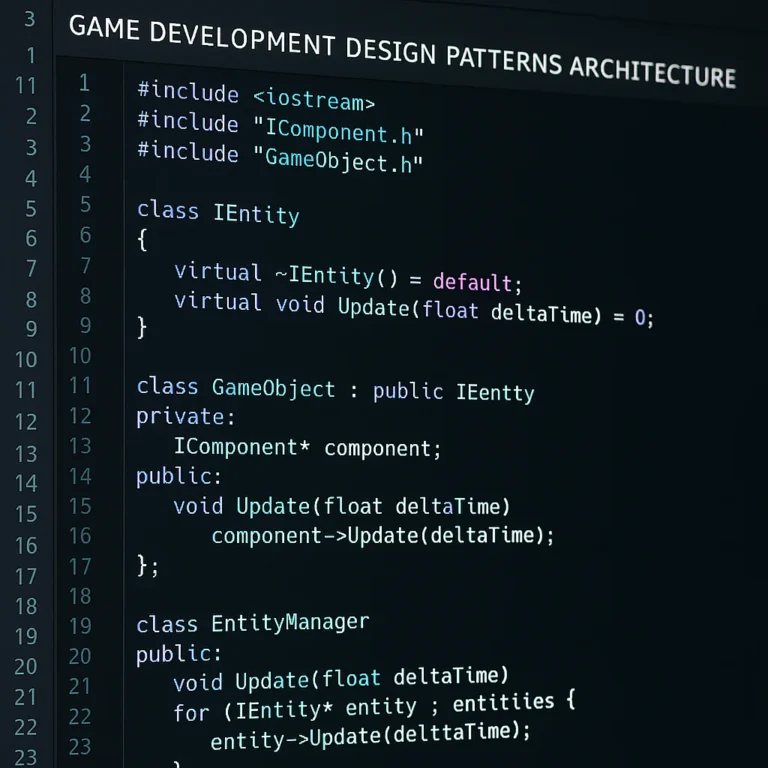
Design patterns transform fragile, unmanageable spaghetti code into robust, scalable architectures by enforcing strict separation of concerns and decoupling complex systems. This is exactly how design patterns improve the maintainability and scalability of game code, allowing teams to add features like new enemy AI or dynamic weather without crashing the entire engine.
Imagine spending six months building a platformer, only to realize that adding a “double jump” mechanic requires rewriting the physics engine, the input system, and the animation controller simultaneously. That nightmare is the hallmark of poor architecture.
Studies show that 70% of a software project’s total cost is spent on maintenance, not initial development. In the gaming industry, where “feature creep” is the norm, ignoring these patterns can turn a promising prototype into an unfixable mess before launch.
We’ve seen studios abandon projects because the codebase became too tangled to support a simple patch. The difference between a game that lasts for years and one that dies in beta often comes down to the structural choices made in the first week of coding.
Key Takeaways
- Decoupling is King: Patterns like Observer and Strategy break tight dependencies, allowing you to swap mechanics without breaking the whole system.
- Scalability Starts Early: Implementing Object Pooling and Component architectures from day one prevents memory spikes and performance hitches as your world grows.
- Maintainability Wins: Using the State Pattern for complex AI or character logic makes debugging and adding new behaviors significantly faster and safer.
- Avoid Over-Engineering: Not every problem needs a complex pattern; apply the YAGNI principle to keep your codebase lean and focused.
Table of Contents
- ⚡️ Quick Tips and Facts
- 📜 From Spaghetti Code to Structured Systems: A Brief History of Game Architecture
- 🧱 The Core Mechanics: How Design Patterns Fortify Game Code Maintainability
- 🚀 Scaling Up: Leveraging Patterns for Expansive Game Worlds
- 🛠️ Essential Design Patterns Every Game Developer Must Master
- 1. The Singleton Pattern: Managing Global Game State Without Chaos
- 2. The Observer Pattern: Decoupling Systems for Smooth Event Handling
- 3. The State Pattern: Taming Complex Character Behaviors and AI Logic
- 4. The Strategy Pattern: Swapping Algorithms for Dynamic Gameplay Mechanics
- 5. The Component Pattern: Building Flexible Entities with Entity-Component-System (ECS)
- 6. The Flyweight Pattern: Optimizing Memory for Massive Object Counts
- 7. The Command Pattern: Implementing Undo/Redo and Input Buffering
- 8. The Object Pool Pattern: Eliminating Garbage Collection Hitches
- 🧩 Real-World Case Studies: How AAA Studios Apply Patterns
- ⚖️ The Double-Edged Sword: When Design Patterns Become Over-Engineering
- 🔄 Refactoring Legacy Code: A Step-by-Step Guide to Introducing Patterns
- 🤖 Design Patterns vs. Modern Game Engines: Do You Still Need Them?
- 🎓 Learning Resources: Books, Courses, and Communities for Game Architects
- ❓ Frequently Asked Questions About Game Design Patterns
- 🔗 Recommended Links and Tools
- 📚 Reference Links and Further Reading
- 🏁 Conclusion: Building Games That Last
⚡️ Quick Tips and Facts
Before we dive into the deep end of the codebase, let’s hit the pause button and grab a few lifelines. If you’re here because your game project feels like a tangled ball of yarn that you can’t find the end of, you’re in the right place.
Here are the non-negotiable truths about design patterns in game development:
- Patterns are not magic spells. They won’t fix bad logic; they just organize it. As the saying goes, “You can’t put lipstick on a pig, but you can put a design pattern on it to make it easier to walk.”
- The “Spaghetti Code” syndrome is the #1 killer of game projects. It happens when you have 50 lines of
if/elsestatements in a singleUpdate()function. - Scalability isn’t just about server load. It’s about how easily a new developer can add a “double jump” mechanic without breaking the “dodge roll” logic.
- Over-enginering is real. Using a Factory pattern to create a single
Playerobject is like using a sledgehammer to crack a nut. It’s loud, messy, and unnecessary. - The “Golden Rule”: If you find yourself copying and pasting code more than twice, you likely need a pattern.
For a deeper dive into the philosophy behind these structures, check out our guide on coding design patterns right here at Stack Interface™.
📜 From Spaghetti Code to Structured Systems: A Brief History of Game Architecture

Let’s take a trip down memory lane, shall we? 🕰️
In the early days of gaming (think 8-bit era), code was often written in assembly or C, and “architecture” was a luxury few could afford. You wrote what worked, and if it crashed, you restarted the console. The code was linear, monolithic, and terrifyingly fragile.
As games grew more complex, so did the code. We entered the era of the “Big Ball of Mud.” This is a term coined by Brian Fote and Joseph Yoder to describe a system where the structure is so intertwined that no one dares touch it. Imagine a game where the inventory system is hard-coded into the enemy AI. If you want to change how a sword is dropped, you might accidentally make the dragon fly backward. 🐉🔙
The turning point came when software engineers realized that reusability and maintainability were just as important as functionality. The Gang of Four (GoF) published their seminal book, Design Patterns: Elements of Reusable Object-Oriented Software, in 194. While not written specifically for games, these patterns became the life raft for game developers drowning in complexity.
Fast forward today, and we see a shift. Modern engines like Unity and Unreal Engine have baked many of these patterns into their core architectures. But here’s the kicker: knowing why they are there is what separates a script kiddie from a software architect.
“Writing code that works is the starting point. Writing code that lasts, scales, and other developers can understand is the actual goal.” — Ankit Pangasa
🧱 The Core Mechanics: How Design Patterns Fortify Game Code Maintainability
So, how exactly do these abstract concepts translate to maintainable code?
Maintainability is the ability to fix bugs, add features, and refactor code without causing a cascade of failures. Design patterns achieve this through three main pillars:
1. Decoupling: The Art of Not Holding Hands
In a tightly coupled system, Module A knows everything about Module B. If Module B changes, Module A breaks.
- The Problem: Your
PlayerControllerdirectly instantiates aHealthManager. If you change theHealthManager‘s constructor, you have to recompile thePlayerController. - The Solution: Patterns like Dependency Injection and the Observer Pattern allow modules to communicate via interfaces or events. They don’t need to know who they are talking to, just what they are saying.
2. Single Responsibility Principle (SRP)
Every class should have one, and only one, reason to change.
- The Problem: A
GameManagerclass that handles input, saves the game, manages the UI, and calculates physics. - The Solution: Break it down. Use the Facade Pattern to provide a simple interface to a complex subsystem, or the Component Pattern to split logic into reusable chunks.
3. Open/Closed Principle
Software entities should be open for extension, but closed for modification.
- The Problem: To add a new weapon type, you have to open the
WeaponFactoryand add a newcaseto a massiveswitchstatement. - The Solution: The Strategy Pattern allows you to plug in new behaviors without touching the existing code.
Pro Tip: If you find yourself modifying a class every time you want to add a new feature, you are violating the Open/Closed Principle. It’s time to refactor!
For more on how to structure your backend logic effectively, visit our Back-End Technologies category.
🚀 Scaling Up: Leveraging Patterns for Expansive Game Worlds
Scaling a game isn’t just about handling more players; it’s about handling more complexity without the codebase collapsing under its own weight.
The “Feature Crep” Nightmare
You start with a simple platformer. Then you add RPG elements. Then you add a crafting system. Then a day/night cycle. Then a multiplayer lobby. Suddenly, your codebase is a labyrinth.
Design patterns act as the blueprints that allow you to expand the building without tearing down the foundation.
| Challenge | Pattern Solution | Benefit |
|---|---|---|
| Adding new enemy types | Factory Method | New enemies are created without modifying the spawner logic. |
| Complex AI behaviors | State Pattern | AI logic is split into distinct states (Idle, Chase, Attack) rather than one giant Update function. |
| Dynamic difficulty | Strategy Pattern | Difficulty algorithms can be swapped at runtime without recompiling. |
| Massive object counts | Object Pool | Reuses objects instead of creating/destroying them, preventing memory spikes. |
| Cross-system events | Observer Pattern | The UI updates when health changes without the Health system knowing about the UI. |
Real-World Scaling: The Open World Dilemma
Consider an open-world game like The Witcher 3 or Red Dead Redemption 2. How do they manage thousands of NPCs, dynamic weather, and a persistent world?
- They use Spatial Partitioning (a variation of the Flyweight and Component patterns) to only update objects near the player.
- They use Event-Driven Architecture (Observer) so that the weather system doesn’t need to poll the NPC system every frame.
If you’re building a massive multiplayer game, you’ll want to check out our insights on AI in Software Development to see how patterns help manage intelligent agents at scale.
🛠️ Essential Design Patterns Every Game Developer Must Master
We’ve talked about the “why,” but now let’s get our hands dirty with the “how.” Here are the 8 patterns that will save your sanity.
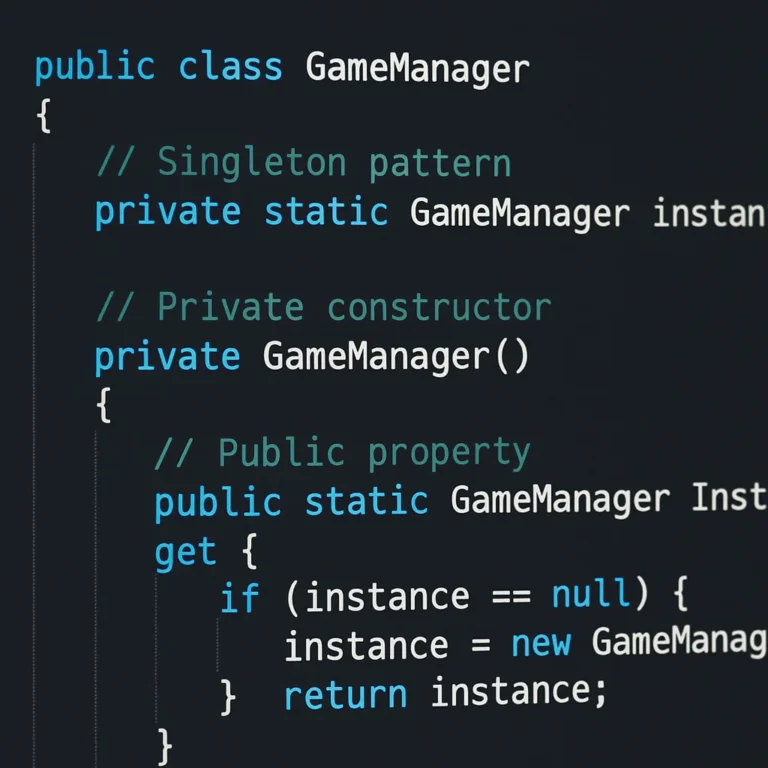
1. The Singleton Pattern: Managing Global Game State Without Chaos
The Singleton ensures a class has only one instance and provides a global point of access to it.
- Use Case: Game Managers, Audio Managers, Save Systems.
- The Good: Easy access to global state. No need to pass references around.
- The Bad: Can lead to hidden dependencies and make unit testing a nightmare. It’s often called an “anti-pattern” if overused.
- The Verdict: Use it sparingly. Only for things that must be single, like the
GameManager.
// A simple Singleton implementation in C#
public class GameManager {
 private static GameManager _instance;
 public static GameManager Instance {
 get {
 if (_instance == null) {
 _instance = new GameManager();
 }
 return _instance;
 }
 }
 // ...
}
2. The Observer Pattern: Decoupling Systems for Smooth Event Handling
This pattern defines a one-to-many dependency between objects. When one object changes state, all its dependents are notified.
- Use Case: UI updates, Achievement systems, Event buses.
- The Good: Loose coupling. The
HealthSystemdoesn’t need to know about theUIor theAchievementSystem. - The Bad: Can lead to “spaghetti events” if not managed carefully. Debuging can be tricky because the flow of execution is hidden.
- The Verdict: Essential for any game with a complex UI or achievement system.
3. The State Pattern: Taming Complex Character Behaviors and AI Logic
Instead of a massive if/else block checking if (isAttacking), if (isJumping), if (isDead), the State Pattern encapsulates each behavior into its own class.
- Use Case: Character controllers, AI behavior trees.
- The Good: Makes complex logic readable and extensible. Adding a new state (e.g.,
Crouching) is as simple as creating a new class. - The Bad: Can lead to a proliferation of small classes.
- The Verdict: A must-have for any character with more than two states.
4. The Strategy Pattern: Swapping Algorithms for Dynamic Gameplay Mechanics
The Strategy pattern defines a family of algorithms, encapsulates each one, and makes them interchangeable.
- Use Case: Different weapon behaviors, AI difficulty levels, movement mechanics.
- The Good: Allows runtime switching of behavior. You can change a character’s movement from “Run” to “Fly” without changing the character class.
- The Bad: Increases the number of classes in your project.
- The Verdict: Perfect for games with moding support or dynamic difficulty.
5. The Component Pattern: Building Flexible Entities with Entity-Component-System (ECS)
This is the backbone of modern game engines like Unity and Godot. Instead of deep inheritance hierarchies (e.g., Enemy inherits from Character inherits from GameObject), you compose entities from components.
- Use Case: Almost everything in modern game dev.
- The Good: Extreme flexibility. You can add a
HealthComponentto aPlayeror aRockwithout rewriting the base class. - The Bad: Can be harder to debug due to the lack of clear hierarchy.
- The Verdict: The standard for scalable game architecture.
6. The Flyweight Pattern: Optimizing Memory for Massive Object Counts
Flyweight minimizes memory usage by sharing as much data as possible between similar objects.
- Use Case: Rendering thousands of trees, particles, or bullets.
- The Good: Drastically reduces memory footprint.
- The Bad: Adds complexity to the code.
- The Verdict: Critical for mobile games or open-world titles with dense populations.
7. The Command Pattern: Implementing Undo/Redo and Input Buffering
The Command pattern encapsulates a request as an object, thereby letting you parameterize clients with queues, requests, and operations.
- Use Case: Input systems, Undo/Redo in strategy games, Macro recording.
- The Good: Decouples the invoker (input) from the receiver (action). Makes undo/redo trivial.
- The Bad: Can create a lot of small objects if not pooled.
- The Verdict: Essential for strategy games and robust input systems.
8. The Object Pool Pattern: Eliminating Garbage Collection Hitches
Instead of creating and destroying objects (which triggers Garbage Collection), you reuse a pool of pre-allocated objects.
- Use Case: Bulets, particles, enemies, UI elements.
- The Good: Prevents frame rate drops caused by GC.
- The Bad: Requires manual management of the pool.
- The Verdict: Non-negotiable for high-performance games.
🧩 Real-World Case Studies: How AAA Studios Apply Patterns
Let’s look at how the giants do it.
Case Study 1: The Legend of Zelda: Breath of the Wild
Nintendo’s BotW is a masterclass in the Component Pattern and State Pattern.
- The Chemistry Engine: The game doesn’t have a “Fire” class. Instead, it has a
BurnableComponent, aFlammableComponent, and aHeatSourceComponent. When they interact, the engine calculates the result. This modularity allows for emergent gameplay (e.g., metal weapons conducting electricity). - The AI: Enemies use a State Machine that reacts to the player’s actions dynamically. If you shoot a rock, the enemy enters a “Search” state. If you hide, they enter a “Lost” state.
Case Study 2: Overwatch
Blizzard’s Overwatch relies heavily on the Observer Pattern and Command Pattern.
- The Ability System: Every hero’s ability is a Command. This allows for the complex interaction of abilities (e.g., Zarya’s barrier absorbing a projectile) and the “undo” mechanics in the replay system.
- The UI: The HUD updates via Observer. When a player’s health changes, the health bar updates, the sound plays, and the kill feed updates—all without the health system knowing about any of them.
⚖️ The Double-Edged Sword: When Design Patterns Become Over-Engineering
Here’s the hard truth: Design patterns can be your worst enemy if you misuse them.
We’ve all seen it: a junior developer trying to force a Factory Pattern into a simple script that just needs to spawn a single enemy. Or a team building a complex Mediator system for a game that only has three interacting objects.
The Signs of Over-Engineering
- Premature Optimization: Implementing a pattern “just in case” you need it later.
- Complexity for Complexity’s Sake: Making the code harder to read to satisfy a theoretical design.
- Ignoring the YAGNI Principle: “You Ain’t Gonna Need It.” If you don’t need it now, don’t build it.
“Good design isn’t about complexity, it’s about restraint.” — Ankit Pangasa
When to avoid patterns:
- Protyping: When you’re just trying to see if a mechanic is fun, keep it simple.
- Small Scripts: If a script is less than 50 lines, a pattern is likely overkill.
- One-off features: If a feature will never be reused, don’t abstract it.
🔄 Refactoring Legacy Code: A Step-by-Step Guide to Introducing Patterns
So, you’ve inherited a codebase that looks like a horror movie. How do you fix it?
Step 1: Identify the Pain Points
Look for the “code smells”:
- Long methods (>50 lines).
- Massive
switchstatements. - Classes that do too much.
- High coupling (classes that know too much about each other).
Step 2: Write Tests First
Before you refactor, write unit tests. This ensures you don’t break anything while you’re moving things around.
Step 3: Apply the Smallest Pattern Possible
Don’t rewrite the whole engine. Start with the State Pattern for a specific character’s AI. Or use the Observer Pattern to decouple a UI element.
Step 4: Refactor in Small Increments
Make small changes, run tests, commit. Repeat.
Step 5: Document the Changes
Explain why you introduced a pattern. Future you (and your teammates) will thank you.
For more on cleaning up messy code, check out our Coding Best Practices section.
🤖 Design Patterns vs. Modern Game Engines: Do You Still Need Them?
With engines like Unity and Unreal providing built-in systems for AI, physics, and UI, do we still need to know design patterns?
The short answer: Yes.
The long answer:
- Unity’s
MonoBehaviouris essentially a Component Pattern implementation. Understanding why it works helps you use it better. - Unreal’s Event Dispatchers are the Observer Pattern in action.
- Unity’s ScriptableObjects are a form of the Flyweight or Factory pattern.
If you don’t understand the underlying patterns, you’re just using the engine’s tools blindly. When the engine’s default solution doesn’t fit your specific need, you’ll be stuck. Knowing the patterns allows you to extend the engine, not just use it.
🎓 Learning Resources: Books, Courses, and Communities for Game Architects
Ready to level up your skills? Here are the resources we swear by at Stack Interface™.
Books
- “Head First Design Patterns” by Eric Freeman & Elisabeth Robson: The best book for beginners. It’s funny, visual, and practical.
- “Game Programming Patterns” by Robert Nystrom: The bible for game devs. It’s free online and specifically tailored to games.
- “Clean Code” by Robert C. Martin: Not game-specific, but essential for writing maintainable code.
Online Resources
- Refactoring.Guru: The clearest visual guide to design patterns available.
- GameDev.net: A classic community with tons of tutorials.
- Stack Overflow: For specific implementation questions.
Courses
- Udemy: Look for courses by GameDev.tv or similar high-rated instructors.
- Coursera: Offers specialized courses on software architecture.
🏁 Conclusion: Building Games That Last

We started this journey by asking: How do design patterns improve the maintainability and scalability of game code?
The answer is simple yet profound: They turn chaos into order.
Design patterns are not just academic concepts or interview buzzwords. They are the thinking frameworks that allow us to build games that can grow, adapt, and survive. They decouple our systems, making it easier to add new features without breaking old ones. They manage complexity, allowing us to build worlds that feel alive and responsive.
But remember the warning: Don’t over-enginer. Use patterns when you have a problem to solve, not just because you can. The best code is often the simplest code that does the job.
So, the next time you find yourself staring at a wall of if/else statements, take a deep breath. Ask yourself: “What pattern can untangle this mess?” Whether it’s the State Pattern for your AI, the Observer Pattern for your UI, or the Object Pool for your bullets, the solution is likely already out there, waiting to be applied.
Your game code is a living thing. Treat it with care, structure it with intention, and it will reward you with a project that stands the test of time.
🔗 Recommended Links and Tools
Ready to start building? Here are some tools and resources to get you started.
👉 Shop Game Development Books on:
- Head First Design Patterns: Amazon | Publisher
- Game Programming Patterns: Amazon | Official Site
- Clean Code: Amazon | Publisher
👉 Shop Game Development Software on:
- Unity Engine: Unity Official | Amazon
- Unreal Engine: Epic Games Official | Amazon
- Godot Engine: Godot Official | Amazon
❓ Frequently Asked Questions About Game Design Patterns
What are the best design patterns for scalable game architecture?
The Component Pattern (ECS) is widely considered the best for scalability, as it allows for flexible entity composition. The Observer Pattern is crucial for decoupling systems, and the Object Pool Pattern is essential for performance at scale.
How do design patterns reduce technical debt in game development?
Design patterns enforce separation of concerns and single responsibility, making code easier to understand and modify. This reduces the likelihood of “quick fixes” that accumulate into technical debt.
Which design patterns are most effective for maintaining large game codebases?
The State Pattern for complex behaviors, the Strategy Pattern for interchangeable algorithms, and the Facade Pattern for simplifying complex subsystems are highly effective for large codebases.
Can design patterns improve the scalability of multiplayer game servers?
Absolutely. The Command Pattern is great for handling network requests and undo/redo logic, while the Observer Pattern helps manage real-time events and state synchronization across clients.
How does the Singleton pattern affect game code maintainability?
While convenient, the Singleton pattern can lead to tight coupling and make unit testing difficult. It should be used sparingly, only for truly global resources like the GameManager.
What are common mistakes when applying design patterns in game engines?
Common mistakes include over-enginering simple problems, using patterns “just in case,” and ignoring the specific context of the game engine. Always ask: “Does this pattern solve a real problem?”
How do design patterns facilitate easier unit testing in game development?
By decoupling components (e.g., using Dependency Injection and Observer), patterns allow you to test individual parts of the system in isolation, making unit testing more straightforward and reliable.
Why should I avoid using the Singleton pattern for everything?
Using Singleton for everything creates a “God Object” that knows too much and does too much. It makes the code hard to test and prone to hidden dependencies. Use it only when a single instance is absolutely necessary.
Can I mix multiple patterns in a single game project?
Yes! In fact, most large-scale games use a combination of patterns. The key is to use the right tool for the job and avoid forcing a pattern where it doesn’t fit.
📚 Reference Links and Further Reading
- Gang of Four (GoF) Book: Design Patterns: Elements of Reusable Object-Oriented Software
- Refactoring.Guru: Design Patterns
- Game Programming Patterns: Game Programming Patterns by Robert Nystrom
- Unity Learn: Unity Scripting
- Unreal Engine Documentation: Unreal Engine C++ Guide
- Medium Article: Learning the basics of Algorithms — why should I care?
- IEEE Xplore: Access IEEE Xplore (Note: Access may be restricted)
- LinkedIn Article: 15 Most Common Design Patterns
🎥 Featured Video

For a visual breakdown of behavioral patterns, check out this insightful video that dives deep into how objects communicate in a clean, organized way.
Watch: Behavioral Design Patterns Explained
In the video, the presenter breaks down the “Social Life of Objects” and explains how patterns like Chain of Responsibility, Command, and Mediator solve real-world communication problems. It’s a must-watch for anyone looking to untangle their code.