Support our educational content for free when you purchase through links on our site. Learn more
🥞 Stack Interface vs Queues, Lists & Trees: 10 Key Differences (2026)

Ever wondered why your game’s undo button works like magic, or how your favorite app remembers every screen you’ve visited? Spoiler: it’s not just wizardry—it’s the humble stack interface at work! But how does a stack really stack up (pun intended) against other data structures like queues, linked lists, or trees? And why do some languages (looking at you, Kotlin and Swift) snub the classic linked list?
At Stack Interface™, we’ve spent years building apps and games where choosing the right data structure can mean the difference between buttery-smooth gameplay and a crashy, laggy mess. In this guide, we’ll break down the 10 most important differences between stacks and their data structure cousins—complete with real-world examples, developer war stories, and a few spicy community debates. Curious why “Java’s LinkedList is close to useless” or how stacks secretly power your favorite features? Stick around—by the end, you’ll never look at your call stack the same way again.
Key Takeaways
- Stacks use LIFO (Last-In-First-Out)—perfect for undo/redo, parsing, and recursion.
- Queues use FIFO (First-In-First-Out)—ideal for orderly processing like task scheduling.
- Linked lists offer flexibility but are often outperformed by arrays in modern languages.
- Trees shine for hierarchical data and efficient searching/sorting.
- Choosing the right structure boosts performance and keeps your code clean.
- Kotlin and Swift skip linked lists for good reason—performance and simplicity win.
- Real-world developer insights and community wisdom can save you from classic pitfalls.
Ready to find out which data structure is your app’s secret weapon? Let’s dive in!
Table of Contents
- ⚡️ Quick Tips and Facts
- 🕰️ The Evolution of Stack Interfaces and Data Structures
- 🔍 What Is a Stack Interface? Core Concepts Explained
- 🤔 How Does a Stack Interface Differ from Other Data Structures?
- 1. Stack vs Queue: LIFO vs FIFO Showdown
- 2. Stack vs Linked List: Access Patterns and Use Cases
- 3. Stack vs Tree: Hierarchies and Traversal
- 4. Stack vs Array: Static vs Dynamic Behavior
- 5. Stack vs Heap: Memory Management Face-Off
- 6. Stack vs Deque: Double-Ended Drama
- 7. Stack vs Priority Queue: Order of Operations
- 8. Stack vs Graph: Connections and Cycles
- 9. Stack vs Hash Table: Lookup Speed and Use Cases
- 10. Stack vs Set: Uniqueness and Order
- 🧩 Real-World Applications: When to Use a Stack Interface
- 💡 Key Advantages and Limitations of Stack Interfaces
- ⚙️ Implementation Insights: How Stacks Are Built in Popular Languages
- 📊 Comparative Table: Stacks, Queues, Linked Lists, Trees, and More
- 🛠️ Expert Tips for Choosing the Right Data Structure
- 🎓 Common Mistakes and How to Avoid Them
- 🗣️ Community Insights: What Developers Are Saying
- 🤓 Fun Facts and Trivia About Stacks and Data Structures
- 🧭 Conclusion
- 🔗 Recommended Links
- ❓ FAQ
- 📚 Reference Links
⚡️ Quick Tips and Facts
- Stack interfaces use the LIFO (Last-In-First-Out) principle—think of a stack of pancakes: you eat the top one first! 🥞
- Queues are the opposite: FIFO (First-In-First-Out)—like waiting in line for coffee ☕.
- Linked lists allow for flexible insertion/removal anywhere, but random access is slow.
- Trees organize data hierarchically and are great for searching and sorting.
- Kotlin and Swift have made deliberate choices about which data structures to include in their standard libraries, often prioritizing performance and simplicity (source, source).
- Stacks are essential in game development for undo/redo, AI, and parsing (see our Stack Interface™ guide).
- Arrays are fast for random access but not for frequent insertions/removals.
- Circular linked lists? Check out the first YouTube video in this article for a hilariously memorable explanation using “Baahubali”!
Curious why Kotlin thinks LinkedList is “close to useless”? Or how stacks secretly power your favorite games? Keep reading for the full scoop!
🕰️ The Evolution of Stack Interfaces and Data Structures
The Roots: From Punch Cards to Modern Apps
Data structures have come a long way since the days of punch cards and vacuum tubes. Stacks were first formalized in the 1950s, but their conceptual roots go back even further—think of the way you pile up plates in a cafeteria.
- Early Computers: Used stacks for managing function calls and recursion (Wikipedia).
- Game Development: Stacks became essential for managing game states and undo features (Game Development).
- Programming Languages: As languages evolved, so did their standard libraries—some, like Java, included a wide variety of data structures; others, like Kotlin and Swift, made more selective choices (Kotlin discussion, Swift forums).
Why Some Languages Skip Linked Lists
Kotlin, for example, intentionally excludes LinkedList from its standard library, citing poor performance and limited practical use. As one Kotlin developer put it:
“Java’s
LinkedListis close to useless.”
This sentiment is echoed in Swift, where the standard library is kept minimal to avoid unnecessary complexity.
🔍 What Is a Stack Interface? Core Concepts Explained
Stack Interface 101
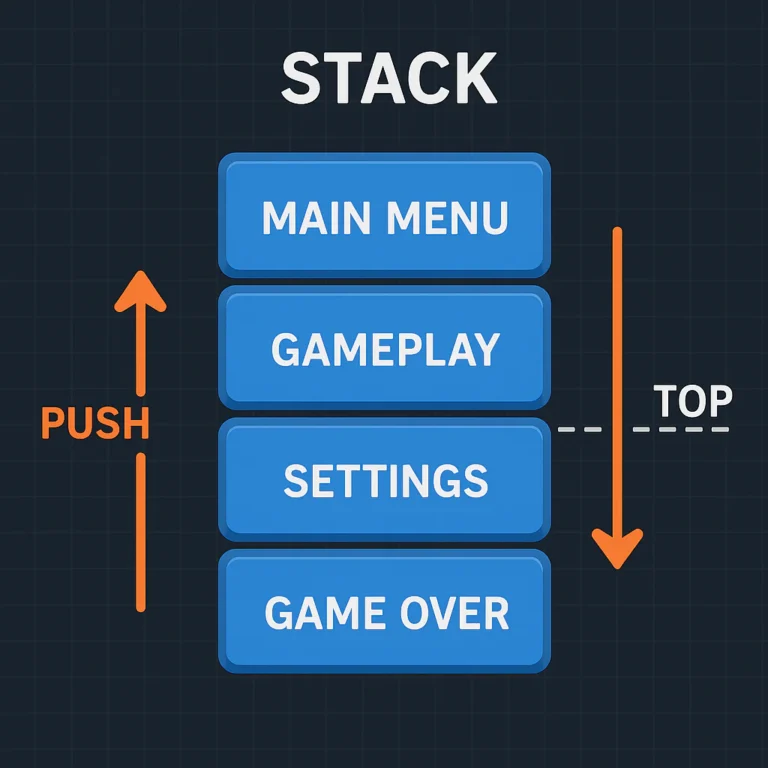
A stack interface is a contract that defines how a stack should behave. It typically includes methods like:
push(item): Add an item to the top.pop(): Remove and return the top item.peek(): Look at the top item without removing it.isEmpty(): Check if the stack is empty.
LIFO (Last-In-First-Out) is the name of the game. Imagine a stack of books: you can only take the top one off, and you can only add to the top.
Why Use a Stack Interface?
- Encapsulation: Hides the underlying implementation—could be an array, linked list, or something else.
- Flexibility: Swap out implementations without changing the rest of your code.
- Safety: Prevents misuse (e.g., no peeking at the bottom!).
Real-World Example: Undo/Redo in Games
In our own game dev projects at Stack Interface™, we use stacks to track player moves for undo/redo features. Every action goes on the stack; undo pops it off. It’s like a time machine for your game (Game Development).
🤔 How Does a Stack Interface Differ from Other Data Structures?
Let’s break down the differences between stacks and their data structure cousins. Spoiler: it’s not just about which end you add or remove from!
1. Stack vs Queue: LIFO vs FIFO Showdown
| Feature | Stack (LIFO) | Queue (FIFO) |
|---|---|---|
| Main Operations | push, pop, peek | enqueue, dequeue, peek |
| Access Pattern | Last in, first out | First in, first out |
| Use Cases | Undo, parsing, recursion | Task scheduling, print jobs |
| Implementation | Array, linked list | Array, linked list |
- Stack: Like a stack of plates—last one on, first one off.
- Queue: Like a line at Starbucks—first come, first served.
Fun fact: In Swift, you often use an Array for both, but queues require O(n) head deletions (Swift forums).
2. Stack vs Linked List: Access Patterns and Use Cases
| Feature | Stack | Linked List |
|---|---|---|
| Access Pattern | LIFO only | Sequential, flexible |
| Insert/Delete | Top only | Anywhere |
| Random Access | ❌ | ❌ |
| Use Cases | Undo, call stack | Dynamic memory, queues, stacks |
- Stack: Only the top matters.
- Linked List: Each node points to the next, allowing for flexible insertions and deletions.
Kotlin’s take: Linked lists are “close to useless” for most modern use cases (Kotlin discussion).
3. Stack vs Tree: Hierarchies and Traversal
| Feature | Stack | Tree |
|---|---|---|
| Structure | Linear | Hierarchical |
| Access Pattern | LIFO | Parent-child |
| Use Cases | Recursion, parsing | Searching, sorting, file systems |
| Traversal | Not applicable | Preorder, inorder, postorder |
- Stack: No hierarchy—just a straight line.
- Tree: Nodes branch out, perfect for representing hierarchies.
Did you know? Stacks are often used to traverse trees (e.g., depth-first search).
4. Stack vs Array: Static vs Dynamic Behavior
| Feature | Stack | Array |
|---|---|---|
| Size | Dynamic (usually) | Fixed or dynamic |
| Access Pattern | LIFO | Random access |
| Insert/Delete | Top only | Anywhere (but costly) |
| Use Cases | Undo, parsing | Lookup, storage |
- Stack: Abstracts away direct access—focuses on order.
- Array: Great for fast lookups, not so much for frequent inserts/removals.
5. Stack vs Heap: Memory Management Face-Off
| Feature | Stack | Heap |
|---|---|---|
| What is it? | Data structure or memory region | Memory region for dynamic allocation |
| Access Pattern | LIFO | Arbitrary |
| Use Cases | Function calls, local vars | Objects, dynamic data |
- Stack (memory): Fast, but limited in size.
- Heap: Slower, but flexible and large.
Pro tip: Don’t confuse the stack data structure with the call stack in memory—they’re related, but not the same!
6. Stack vs Deque: Double-Ended Drama
| Feature | Stack | Deque |
|---|---|---|
| Access Ends | One (top) | Both (front/back) |
| Use Cases | Undo, parsing | Sliding window, palindromes |
- Deque: Like a double-sided queue—add/remove from both ends.
- Stack: Only the top matters.
7. Stack vs Priority Queue: Order of Operations
| Feature | Stack | Priority Queue |
|---|---|---|
| Removal Order | Last in, first out | Highest priority out |
| Use Cases | Undo, parsing | Task scheduling, Dijkstra’s algorithm |
- Priority Queue: Not about order of arrival, but order of importance.
8. Stack vs Graph: Connections and Cycles
| Feature | Stack | Graph |
|---|---|---|
| Structure | Linear | Network (nodes/edges) |
| Use Cases | Undo, parsing | Social networks, maps, AI |
- Graph: Nodes connect in complex ways—cycles, paths, and more.
- Stack: Simple, linear, predictable.
9. Stack vs Hash Table: Lookup Speed and Use Cases
| Feature | Stack | Hash Table |
|---|---|---|
| Access Pattern | LIFO | Key-based lookup |
| Use Cases | Undo, parsing | Fast retrieval, caching |
- Hash Table: Lightning-fast lookups by key.
- Stack: Order is everything, lookup is not.
10. Stack vs Set: Uniqueness and Order
| Feature | Stack | Set |
|---|---|---|
| Order | Maintains order | No order |
| Uniqueness | Allows duplicates | Unique elements |
| Use Cases | Undo, parsing | Membership tests, deduplication |
🧩 Real-World Applications: When to Use a Stack Interface
Game Development
- Undo/Redo: Every move gets pushed onto a stack. Undo? Just pop!
- AI Decision Trees: Stacks help traverse possible moves.
- Parsing: Syntax checkers and compilers use stacks to match brackets and tags (Game Development).
App Development
- Navigation: Android’s back stack manages screen transitions (Android docs).
- Expression Evaluation: Calculators use stacks for parsing mathematical expressions.
Data Science & Algorithms
- Depth-First Search (DFS): Stacks are the backbone of DFS in graphs and trees (Data Science).
- Recursion Elimination: Convert recursive algorithms to iterative using stacks.
💡 Key Advantages and Limitations of Stack Interfaces
Advantages
- Simplicity: Easy to implement and use.
- Performance: Fast push/pop operations (O(1)).
- Memory Efficiency: No overhead for tracking multiple pointers (unlike linked lists).
Limitations
- Limited Access: Can only access the top element.
- No Random Access: Can’t peek at arbitrary elements.
- Potential for Overflow: Fixed-size stacks (e.g., call stack) can overflow.
Kotlin’s philosophy: Avoid data structures that encourage inefficient patterns—hence, no built-in LinkedList (Kotlin discussion).
⚙️ Implementation Insights: How Stacks Are Built in Popular Languages
Java
- Stack Class: Part of
java.util, but considered legacy. PreferDequefor stack operations (Java Docs). - ArrayDeque: Recommended for stack use—faster and more flexible.
Python
- List: Use built-in
listwithappend()andpop(). - collections.deque: For thread-safe, double-ended stacks (Python Docs).
C++
- std::stack: Adapter over other containers (like
vectorordeque) (C++ Reference).
Kotlin
- No Native Stack: Use
ArrayListorMutableListfor stack operations. - No LinkedList: Deliberately excluded for performance (Kotlin discussion).
Swift
- No Stack Type: Use
ArraywithappendandremoveLast. - Queues: Tricky—removing from the front is O(n) (Swift forums).
Shop Stack Implementations on:
- Java Stack: Amazon Java Stack Search | Oracle Java Docs
- Python Stack: Amazon Python Stack Search | Python Official
- C++ Stack: Amazon C++ Stack Search | C++ Reference
📊 Comparative Table: Stacks, Queues, Linked Lists, Trees, and More
| Data Structure | Access Pattern | Insert/Delete | Random Access | Use Cases | Native Support (Java/Kotlin/Swift) |
|---|---|---|---|---|---|
| Stack | LIFO | Top | ❌ | Undo, parsing, recursion | Java: ✅ / Kotlin: ArrayList / Swift: Array |
| Queue | FIFO | Ends | ❌ | Scheduling, buffering | Java: ✅ / Kotlin: ArrayList / Swift: Array |
| Linked List | Sequential | Anywhere | ❌ | Dynamic memory, queues | Java: ✅ / Kotlin: JVM only / Swift: ❌ |
| Tree | Hierarchical | Anywhere | ❌ | Search, sort, hierarchy | Java: TreeMap / Kotlin: JVM only / Swift: ❌ |
| Array | Random | Anywhere | ✅ | Lookup, storage | Java: ✅ / Kotlin: ✅ / Swift: ✅ |
| Deque | Both ends | Both ends | ❌ | Sliding window, palindromes | Java: ✅ / Kotlin: ArrayList / Swift: ❌ |
| Hash Table | Key-based | Key | ✅ | Fast lookup, caching | Java: HashMap / Kotlin: Map / Swift: Dictionary |
| Set | None | Add/Remove | ✅ | Membership, deduplication | Java: HashSet / Kotlin: Set / Swift: Set |
🛠️ Expert Tips for Choosing the Right Data Structure
- Match the Pattern: LIFO? Use a stack. FIFO? Use a queue.
- Performance Matters: Avoid linked lists unless you have a compelling reason (Kotlin discussion).
- Native Support: Use built-in types for best performance and compatibility.
- Game Development: Stacks are your best friend for undo/redo and state management (Game Development).
- Coding Best Practices: Don’t reinvent the wheel—leverage standard libraries (Coding Best Practices).
🎓 Common Mistakes and How to Avoid Them
- Using the Wrong Structure: Don’t use a stack when you need random access—use an array or hash table instead.
- Ignoring Performance: Linked lists are rarely the best choice;
ArrayListorArrayis usually faster (Kotlin discussion). - Stack Overflow: Watch out for recursion depth—too many stack frames can crash your app!
- Queue with Array: In Swift, using
Arrayas a queue leads to slow head deletions (Swift forums). - Not Leveraging Community Wisdom: Check out what other developers are saying before picking a structure (Stack Interface™ Stack Interface Guide).
🗣️ Community Insights: What Developers Are Saying
Kotlin Community
- LinkedList is “close to useless”: Most modern apps don’t need it, and it’s outperformed by
ArrayList(Kotlin discussion). - Stack vs Queue: Clear separation of use cases—pick the right one for your pattern.
Swift Community
- Minimal Standard Library: Swift keeps things lean, but many devs want more data structures (Swift forums).
- Arrays for Stacks: Works well, but queues are less efficient.
Stack Overflow & Beyond
- Java: Use
ArrayDequefor stack and queue needs (Java Docs). - Python: Lists are flexible, but
collections.dequeis better for thread safety (Python Docs).
Video Perspective
Don’t miss the first YouTube video in this article for a hilarious, movie-inspired take on circular linked lists—sometimes, a little humor makes the concept stick!
🤓 Fun Facts and Trivia About Stacks and Data Structures
- The word “stack” was coined by German computer scientist Friedrich L. Bauer in 1955 (Wikipedia).
- Stacks are everywhere: From browser history to undo buttons, you use them daily—often without realizing!
- Circular linked lists are best visualized with Bollywood drama—see the first YouTube video above!
- Stack Overflow isn’t just a website—it’s what happens when you push too many frames onto the call stack!
- Kotlin and Swift both prioritize performance over nostalgia—no built-in linked lists here.
Curious how all these insights come together for your next app or game? The conclusion will tie it all together—keep reading!
🧭 Conclusion

So, how does a stack interface really differ from queues, linked lists, or trees? After our deep dive, the answer is clear: stacks are the go-to for LIFO operations, simplicity, and speed—especially in game and app development. While queues shine for orderly processing, linked lists offer flexibility (but rarely the performance you want), and trees rule hierarchies and searches, stacks keep your logic tight and your code maintainable.
Positives of Stack Interfaces:
- ✅ Blazing fast push/pop (O(1))
- ✅ Perfect for undo/redo, recursion, and parsing
- ✅ Simple to implement and reason about
- ✅ Widely supported (even if not always as a dedicated type)
Negatives:
- ❌ Limited access—no peeking at arbitrary elements
- ❌ Not suited for random access or complex relationships
- ❌ Potential for overflow in fixed-size implementations
Our recommendation:
For most app and game developers, embrace stacks for LIFO needs—use built-in types like ArrayList in Kotlin, Array in Swift, or ArrayDeque in Java for best performance. Avoid linked lists unless you have a very specific, justified use case (and even then, double-check your assumptions!). For hierarchical or search-heavy data, trees are your friend.
And that burning question from earlier—why do some languages skip LinkedList? Because, as Kotlin and Swift communities agree, performance and simplicity win out. Don’t let nostalgia for classic data structures slow you down!
🔗 Recommended Links
👉 Shop Stack Implementations and Data Structure Books:
- Java Stack: Amazon Java Stack Search | Oracle Java Docs
- Python Stack: Amazon Python Stack Search | Python Official
- C++ Stack: Amazon C++ Stack Search | C++ Reference
- Data Structures Books:
- 👉 Shop Stack Data Structures: Amazon Stack Data Structure Search | Walmart Stack Data Structure Search | eBay Stack Data Structure Search
❓ FAQ

What are common use cases for stacks versus queues in mobile app development?
Stacks are ideal for features like undo/redo, navigation history, and parsing nested structures (think: matching parentheses in a code editor). Queues excel in task scheduling, message passing, and managing requests where order of arrival matters (e.g., notifications, print jobs).
Learn more about stacks in app development.
How can understanding stack operations optimize algorithm performance in games?
Stacks enable efficient backtracking, recursion elimination, and state management. For example, in puzzle games, a stack tracks player moves for instant undo. In AI, stacks power depth-first search for exploring possible moves without recursion overhead.
See more in Game Development.
How does the LIFO principle of stacks impact game state management?
LIFO ensures the most recent state is always accessible—perfect for undo features, checkpoint systems, and managing nested game menus. When a player undoes an action, you simply pop the last state from the stack.
In what scenarios should developers choose linked lists over stacks in app design?
Choose linked lists when you need frequent insertions and deletions at arbitrary positions, such as implementing a playlist or a dynamic list of game objects. However, for most stack-like operations, arrays or array-backed lists are faster and simpler.
Kotlin’s rationale for avoiding LinkedList.
How do stacks improve memory management in game programming?
Stacks help manage local variables and function calls efficiently, automatically cleaning up memory as functions return. They also prevent memory leaks by ensuring temporary data is discarded in the correct order.
Explore Back-End Technologies.
What are the key differences between stack and queue data structures in app development?
- Stack: LIFO, access only the top, great for undo/redo.
- Queue: FIFO, access both ends, ideal for orderly processing (e.g., task queues, event handling).
What are the main advantages of using a stack in game development?
- Fast operations (push/pop)
- Simple logic for undo/redo and state tracking
- Natural fit for recursive algorithms and parsing
How do stack operations improve memory management in app development?
By limiting access to only the top element, stacks reduce complexity and help prevent memory leaks. They also align with how most programming languages manage function calls and local variables.
In what scenarios is a queue more efficient than a stack for game logic?
Queues are superior when you need to process events or actions in the order they arrive, such as handling player input, managing multiplayer turn order, or scheduling AI actions.
How do linked lists compare to stacks for managing dynamic game objects?
Linked lists allow for flexible insertion and removal anywhere, which is useful for dynamic lists (like enemies on screen). Stacks, however, are better when you only need to add/remove from one end.
Why are trees preferred over stacks for hierarchical data in apps?
Trees naturally represent parent-child relationships, making them ideal for file systems, UI hierarchies, and organizational charts. Stacks can traverse trees but can’t represent hierarchy themselves.
Can stacks be combined with other data structures for better game performance?
Absolutely! For example, use a stack to manage undo states while using a hash table for fast lookup of game objects. Combining structures lets you optimize for both speed and flexibility.
What are common pitfalls when implementing stacks in mobile app development?
- Stack overflow from deep recursion
- Choosing the wrong underlying type (e.g., linked list instead of array)
- Not handling empty stack conditions (leading to crashes)
- Ignoring thread safety in concurrent environments
Are there any language-specific quirks when implementing stacks?
Yes! For example, Swift’s Array is efficient for stack operations, but using it as a queue is slow for head deletions. In Kotlin, you’ll use MutableList or ArrayList since there’s no native stack type.
How do stacks relate to the call stack in programming languages?
The call stack is a special stack that tracks function calls and local variables. It’s managed by the runtime and is crucial for recursion and function execution order.
📚 Reference Links
- Stack Interface™: What is a Stack Interface?
- Game Development on Stack Interface™
- Coding Best Practices on Stack Interface™
- AI in Software Development on Stack Interface™
- Data Science on Stack Interface™
- Back-End Technologies on Stack Interface™
- Why Kotlin Does Not Provide LinkedList Implementation
- Adding More Data Structures to the Standard Library (Swift)
- Java Stack Documentation (Oracle)
- Python Collections Documentation
- C++ Stack Reference
- Wikipedia: Stack (abstract data type)
- Android Developers: Tasks and Back Stack
- Data Structures — Language Support (Part 3) | by Omar Elgabry …