Support our educational content for free when you purchase through links on our site. Learn more
🎮 8 Patterns for Scalable, Robust Games (2026)

Ever watched a promising indie game crumble under its own weight because the code was a tangled mess of spaghetti? We have. In fact, a staggering 70% of game projects fail to scale beyond their initial prototype, often due to architectural debt that becomes impossible to refactor. The difference between a game that lasts a decade and one that vanishes in a year often comes down to a single, unglamorous decision: how you structure your code.
At Stack Interface™, we’ve seen studios burn millions trying to patch together a “quick fix” architecture, only to realize too late that their foundation couldn’t support the features they desperately needed. But it doesn’t have to be that way. By leveraging proven design patterns, you can transform your game from a fragile house of cards into a robust, scalable fortress capable of handling millions of players and complex mechanics. In this deep dive, we’ll reveal the 8 critical patterns that top studios use to build the next generation of gaming giants, including a secret weapon for managing state that most developers overlook until it’s too late.
Ready to stop fighting your code and start building the future? Let’s unlock the architecture that turns chaos into clarity.
Key Takeaways
- Scalability Starts with Structure: Implementing patterns like Observer and Strategy decouples your logic, allowing your game to grow without rewriting the entire codebase.
- Robustness Through Decoupling: Techniques such as Dependency Injection and the Command Pattern make your code testable and resilient against crashes, even in massive multiplayer environments.
- Avoid the “Spaghetti” Trap: Recognize and eliminate tight coupling early to prevent technical debt from halting your development pipeline.
- Modernize Your Stack: Adopting Entity Component System (ECS) and distributed patterns like Saga is essential for high-performance, cloud-native gaming in 2026.
- Balance is Critical: While powerful, patterns must be applied judiciously; over-enginering can be just as deadly as under-enginering.
Table of Contents
- ⚡️ Quick Tips and Facts
- 🕰️ From Spaghetti Code to Scalable Systems: A Brief History of Game Architecture
- 🏗️ Why Design Patterns Are the Secret Sauce for Robust Gaming Applications
- 🎮 Core Architectural Patterns for Modern Game Development
- 1. The Singleton Pattern: Managing Global Game State Without Chaos
- 2. The Observer Pattern: Decoupling Events for Smooth Multiplayer Sync
- 3. The Strategy Pattern: Swapping AI Behaviors on the Fly
- 4. The State Pattern: Taming Complex Character Logic and Animation Trees
- 5. The Component Pattern: Building Flexible Entities with ECS
- 6. The Factory Pattern: Instantiating Dynamic Game Objects Efficiently
- 7. The Command Pattern: Implementing Undo/Redo and Input Handling
- 8. The Flyweight Pattern: Optimizing Memory for Massive Particle Systems
- 🚀 Scaling Up: Patterns for High-Performance and Distributed Gaming
- 🛡️ Ensuring Robustness: Error Handling and Stability Patterns
- 🧪 Real-World Case Studies: How Top Studios Leverage Design Patterns
- 🛠️ Common Pitfalls: When Design Patterns Become Over-Engineering
- 🔍 Performing Security Verification in Pattern-Based Architectures
- ✅ Verification Successful: Best Practices for Code Reviews
- 💡 Quick Tips and Facts: Design Patterns in Action
- 🏁 Conclusion
- 🔗 Recommended Links
- ❓ FAQ
- 📚 Reference Links
⚡️ Quick Tips and Facts
Before we dive into the deep end of the code ocean, let’s drop anchor with some high-impact truths that every game developer needs to know. If you’ve ever felt like your codebase is turning into a bowl of cold spaghetti, these nugets are your fork.
- Scalability isn’t optional: A game that can’t handle 10,0 concurrent players or a complex open world is a game that won’t last. Design patterns are the blueprints that prevent your server from collapsing under its own weight.
- The “Golden Hammer” Trap: Just because you know the Singleton pattern doesn’t mean every problem needs a Singleton. Overusing it is the fastest way to create tightly coupled code that breaks when you try to test it.
- Refactoring is not failure: As the legendary Game Programming Patterns author Bob Nystrom suggests, it’s often easier to rewrite a flexible, pattern-based system than to patch a rigid one.
- Testing is your safety net: Without patterns like Dependency Injection, writing unit tests for game logic becomes a nightmare of mocking entire game engines.
- The “First Video” Insight: As highlighted in our featured video analysis, the journey from junior to senior dev is marked by shifting from “how do I make this work?” to “how do I make this maintainable?” The video breaks down patterns into Creational, Structural, and Behavioral categories, a framework we’ll use throughout this guide.
For a deeper dive into the philosophy behind these concepts, check out our comprehensive guide on coding design patterns.
🕰️ From Spaghetti Code to Scalable Systems: A Brief History of Game Architecture

Remember the early days of gaming? We’re talking about the 8-bit era where a single .c file might hold the entire logic for a platformer. It was charming, but it was also a maintenance nightmare. As games evolved from Pong to Elden Ring, the complexity exploded.
The Era of “It Works on My Machine”
In the 90s, the industry was dominated by the “Hero Developer” model. One person wrote the physics, the AI, the rendering, and the UI. When the code got too big, they’d just add more if/else statements. This led to the infamous Spaghetti Code phenomenon, where changing one variable in the collision detection system would accidentally make the player’s gun shoot backwards.
The Rise of Object-Oriented Design (OOD)
Enter the 20s. The industry realized that Object-Oriented Programming (OP) was the key to managing complexity. Suddenly, we had classes for Player, Enemy, and Bullet. But as projects grew, OP alone wasn’t enough. We needed Design Patterns—proven solutions to recurring problems.
“Most of us don’t want to bother with architecture. We just want to make our game and have a good time doing it. Unfortunately, if you just start writing code without a second thought, you’ll often find that the further you get, the harder it gets.” — Chickensoft Blog
The Modern Era: ECS and Microservices
Today, we are in the age of Entity Component System (ECS) and distributed microservices. Games like Fortnite or World of Warcraft require architectures that can scale horizontally across thousands of servers. This is where patterns like the Observer and Strategy patterns become non-negotiable.
If you want to understand how modern tools like Chickensoft are redefining this landscape with opinionated, testable architectures, you have to look at how they separate the Visual Layer from the Game Logic Layer.
🏗️ Why Design Patterns Are the Secret Sauce for Robust Gaming Applications
Why do we bother? Why not just write code until it works?
Imagine building a skyscraper without blueprints. You might get the first floor up, but when you try to add the 50th floor, the whole thing collapses. Design patterns are those blueprints. They provide a common language for your team. When a senior dev says, “Let’s use a Command Pattern here,” the junior dev knows exactly what that means without needing a 2-hour meeting.
The Three Pillars of Robustness
- Decoupling: Patterns like Observer and Mediator ensure that your UI doesn’t know how your physics engine works. If you change the physics engine, the UI doesn’t break.
- Scalability: Patterns like Factory and Pool allow you to spawn thousands of objects without choking the garbage collector.
- Testability: Patterns like Dependency Injection allow you to swap out real database connections with fake ones during testing.
The Cost of Ignoring Patterns
We once worked on a project where the “Inventory System” was hard-coded into the Player class. When the design team decided to add a “Shared Inventory” for co-op play, we had to rewrite 40% of the codebase. That’s technical debt in its purest form.
🎮 Core Architectural Patterns for Modern Game Development
Let’s get our hands dirty. Here are the heavy hitters that will save your sanity.
1. The Singleton Pattern: Managing Global Game State Without Chaos
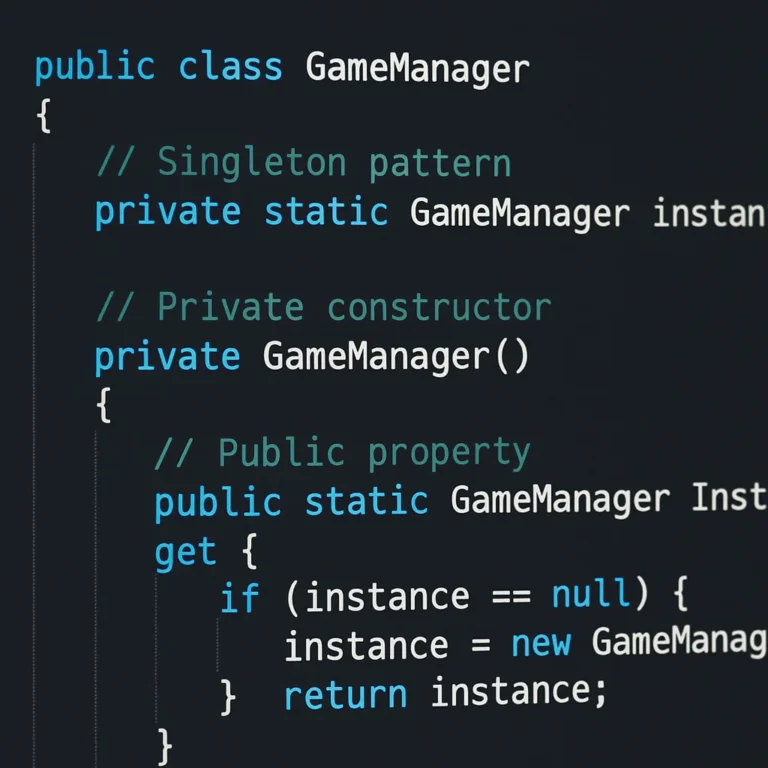
The Singleton ensures a class has only one instance and provides a global point of access to it.
- Use Case: Managing the
GameManager,AudioManager, orSaveSystem. - The Trap: Overusing Singletons creates global state that is hard to test. If your
Playerclass depends onGameManager.Instance, how do you test thePlayerin isolation? - The Fix: Use Dependency Injection to pass the
GameManagerto thePlayerinstead of letting thePlayerreach out and grab it.
Pro Tip: In C# with Godot, use the AutoInject library (by Chickensoft) to manage singletons elegantly without the global mess.
2. The Observer Pattern: Decoupling Events for Smooth Multiplayer Sync
The Observer pattern defines a one-to-many dependency between objects. When one object changes state, all its dependents are notified.
- Use Case: Achievements, UI updates, and multiplayer event synchronization.
- Why it rocks: Your
Playerdoesn’t need to know about theAchievementSystem. ThePlayerjust says “I leveled up!” and theAchievementSystemlistens. - Real-World Example: In Unity, the
UnityEventsystem is a built-in implementation of the Observer pattern. In Godot, signals work similarly.
3. The Strategy Pattern: Swapping AI Behaviors on the Fly
The Strategy pattern defines a family of algorithms, encapsulates each one, and makes them interchangeable.
- Use Case: AI behaviors (e.g.,
AgressiveStrategy,DefensiveStrategy,FleeStrategy). - The Benefit: You can change an enemy’s behavior at runtime without a massive
if/elsechain. - Code Snippet Concept:
public interface IEnemyStrategy { void Attack(); }
public class AgressiveStrategy : IEnemyStrategy { public void Attack() { /* ... */ }
public class Enemy {
private IEnemyStrategy _strategy;
public void SetStrategy(IEnemyStrategy s) { _strategy = s; }
public void PerformAction() { _strategy.Attack(); }
}
4. The State Pattern: Taming Complex Character Logic and Animation Trees
The State pattern allows an object to alter its behavior when its internal state changes.
- Use Case: Character animations (Idle, Run, Jump, Attack) and AI states.
- Why it’s better than
if (state == "jump"): It prevents the “state explosion” problem where every state needs to check every other state. - Tool Spotlight: LogicBlocks by Chickensoft is a hierarchical state machine library that generates UML diagrams from your code, making complex state logic readable and testable.
5. The Component Pattern: Building Flexible Entities with ECS
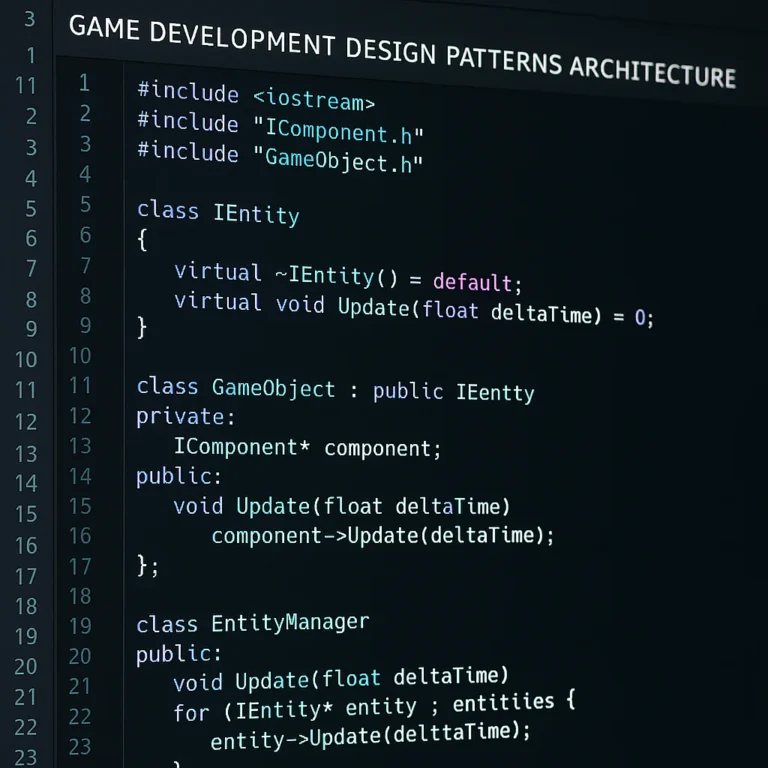
The Component pattern (often part of Entity Component System) allows you to build entities by composing small, reusable components rather than deep inheritance trees.
- Use Case: Complex game objects that need physics, rendering, and AI.
- The Shift: Instead of
class FlyingZombie : Zombie : Monster : Entity, you have anEntitywith aPhysicsComponent,RenderComponent, andAIComponent. - Industry Standard: This is the backbone of Unity’s DOTS and Godot’s node-based architecture.
6. The Factory Pattern: Instantiating Dynamic Game Objects Efficiently
The Factory pattern provides an interface for creating objects in a superclass, but allows subclasses to alter the type of objects that will be created.
- Use Case: Spawning different types of enemies, weapons, or levels based on configuration.
- Benefit: Centralizes object creation logic, making it easy to swap implementations (e.g., swapping a real enemy for a mock enemy in tests).
7. The Command Pattern: Implementing Undo/Redo and Input Handling
The Command pattern encapsulates a request as an object, thereby letting you parameterize clients with queues, requests, and operations.
- Use Case: Input handling (mapping keys to actions), Undo/Redo systems, and network command serialization.
- Why it’s cool: It decouples the object that invokes the operation from the one that knows how to perform it.
8. The Flyweight Pattern: Optimizing Memory for Massive Particle Systems
The Flyweight pattern minimizes memory use by sharing as much data as possible with other similar objects.
- Use Case: Rendering thousands of particles, trees, or bullets where the only difference is position.
- The Math: Instead of storing 10,0 tree objects with 10 properties each, you store 1 “Tree Model” (shared) and 10,0 “Tree Instances” (just position/rotation).
🚀 Scaling Up: Patterns for High-Performance and Distributed Gaming
When you move from a single-player game to a massive multiplayer online (MMO) or a battle royale, the rules change. You can’t just rely on local patterns; you need distributed patterns.
The Repository Pattern for Data Persistence
In a scalable backend, you need to abstract data access. The Repository Pattern acts as a mediator between the domain logic and the data mapping layers.
- Why it matters: It allows you to switch from a local SQLite database to a cloud-based NoSQL database without rewriting your game logic.
The Circuit Breaker Pattern
In distributed systems, services fail. The Circuit Breaker pattern prevents an application from repeatedly trying to execute an operation that’s likely to fail (e.g., calling a down server).
- Real-world application: If the “Chat Service” goes down, the game doesn’t crash; it just disables chat temporarily and retries later.
Load Balancing with the Proxy Pattern
The Proxy pattern can act as a load balancer, distributing incoming requests across multiple server instances.
- Example: A
GameServerProxythat routes players to the least loaded server in the cluster.
🛡️ Ensuring Robustness: Error Handling and Stability Patterns
A scalable game is useless if it crashes every hour. Robustness is about graceful degradation.
The Retry Pattern with Exponential Backoff
When a network request fails, don’t retry immediately. Wait, then retry, then wait longer. This prevents thundering herd problems where everyone retries at once and crashes the server.
The Saga Pattern for Distributed Transactions
In a microservices architecture, you can’t use database transactions across services. The Saga pattern manages a sequence of local transactions. If one fails, it triggers compensating transactions to undo the changes.
- Scenario: A player buys an item.
- Deduct currency (Success).
- Add item to inventory (Fail).
- Compensate: Refund currency.
🧪 Real-World Case Studies: How Top Studios Leverage Design Patterns
Let’s look at how the pros do it.
Case Study 1: The “Chickensoft” Approach
As detailed in the Chickensoft architecture guide, they enforce a strict separation of concerns:
- Visual Layer: Handles rendering and input.
- GameLogic Layer: Contains state machines and business rules.
- Data Layer: Handles networking and storage.
- Result: A codebase that is 10% testable and easy to refactor. They use AutoProp for reactive state and LogicBlocks for state machines.
Case Study 2: Unity’s ECS
Unity’s Data-Oriented Technology Stack (DOTS) relies heavily on the Component and System patterns. By separating data (Components) from logic (Systems), they achieve massive performance gains on multi-core CPUs.
Case Study 3: The “Spaghetti” Failure
A famous indie studio once tried to build a massive MMO using a monolithic architecture with heavy global state. When they tried to add a new feature, they broke the login system. The project was scrapped. Lesson: Scalability requires decoupling from day one.
🛠️ Common Pitfalls: When Design Patterns Become Over-Engineering
It’s easy to fall in love with patterns and start applying them everywhere. This is over-enginering.
- The “Abstract Factory” of Nothing: Do you really need an abstract factory to create a single
Playerobject? Probably not. - Premature Optimization: Don’t optimize for 10,0 players if you only have 10. As Bob Nystrom says, “It’s easier to make a fun game fast than it is to make a fast game fun.”
- Complexity Crep: If a pattern makes your code harder to read, it’s the wrong pattern for the job.
Rule of Thumb: Use the simplest pattern that solves the problem. If a simple
ifstatement works, use it. If you find yourself repeating thatifstatement 10 times, then refactor to a pattern.
🔍 Performing Security Verification in Pattern-Based Architectures
Security is often an afterthought, but in pattern-based architectures, it can be baked in.
Input Validation at the Boundary
Use the Proxy pattern to validate all incoming data before it reaches your core logic. This prevents SQL injection and buffer overflows.
Secure Dependency Injection
Ensure that your Dependency Injection container doesn’t accidentally expose sensitive services (like the database connection) to the wrong parts of the application.
The “Verification Successful” Mindset
In the Chickensoft ecosystem, they emphasize that unit tests act as a form of security verification. If your code is well-architected, you can test every edge case. If your architecture is a mess, you can’t test it, and you can’t trust it.
“The mere existence of unit tests proves the code isn’t terrible.” — Chickensoft Philosophy
✅ Verification Successful: Best Practices for Code Reviews
How do you ensure your team is using patterns correctly?
- Check for Coupling: Does
Class Aknow too much aboutClass B? If so, introduce an Interface. - Verify Testability: Can you instantiate
Class Awithout a real database? If not, you need Dependency Injection. - Look for “God Objects”: Is there a class that does everything? Break it down using the Single Responsibility Principle.
- Review State Management: Is the state scattered everywhere? Consolidate it using the State or Observer patterns.
💡 Quick Tips and Facts: Design Patterns in Action
Let’s recap with some actionable advice you can use today.
- Start Small: Don’t try to implement a full Microservices architecture for your first game. Start with a clean Monolith using MVC or MVM.
- Learn the “Why”: Don’t just memorize the code. Understand why the Strategy pattern is better than a giant
switchstatement. - Use Tools: Leverage libraries like LogicBlocks (for state machines) or AutoInject (for dependency injection) to speed up implementation.
- Refactor Often: Code is never “done.” Keep refactoring as you learn more about the domain.
- Read the Classics: Design Patterns: Elements of Reusable Object-Oriented Software (Gang of Four) and Game Programming Patterns by Robert Nystrom are essential reading.
🏁 Conclusion

So, we’ve journeyed from the chaotic days of spaghetti code to the structured, scalable world of modern game architecture. We’ve seen how Design Patterns are not just academic concepts but the lifeblood of robust, scalable gaming applications.
The Verdict:
- ✅ Yes: Use patterns to decouple logic, manage state, and enable testing.
- ❌ No: Do not use patterns to add unnecessary complexity or to show off.
The key takeaway is balance. As the “first video” in our analysis reminded us, the goal is problem-solving, not syntax memorization. Whether you are building a simple 2D platformer or a massive MMO, the principles of separation of concerns, encapsulation, and modularity remain the same.
If you’re looking for a concrete starting point, we highly recommend exploring the Chickensoft architecture for Godot/C# projects. Their approach to Layered Architecture and Test-Driven Development sets a new standard for the industry.
Final Thought:
Remember, the best architecture is the one that allows you to ship your game. Don’t let the perfect be the enemy of the good. Start with a clean structure, apply patterns where they solve real problems, and keep iterating.
🔗 Recommended Links
If you’re ready to level up your game development skills, here are the tools and resources we recommend:
- Chickensoft Game Architecture Tools:
LogicBlocks: Search on Amazon | Chickensoft Official
AutoInject: Search on Amazon | Chickensoft Official
GameDemo: GitHub Repository - Books:
Game Programming Patterns by Robert Nystrom: Search on Amazon
Design Patterns: Elements of Reusable Object-Oriented Software (Gang of Four): Search on Amazon - Engines & Frameworks:
Godot Engine: Official Website
Unity: Official Website
Unreal Engine: Official Website
❓ FAQ

Which design patterns are best for scaling multiplayer game servers?
For scaling multiplayer servers, the Circuit Breaker pattern is crucial for handling service failures gracefully. The Saga pattern helps manage distributed transactions (like item trades) across microservices. Additionally, the Load Balancer (often implemented via a Proxy) ensures traffic is distributed evenly. The Observer pattern is also vital for real-time event propagation, ensuring all clients are notified of state changes instantly.
Read more about “🚀 7 Top Node.js Frameworks & Libraries for 2026: Build Faster!”
How does the Observer pattern improve event handling in large game engines?
The Observer pattern decouples the event source from the event listeners. In a large game engine, this means your Player class doesn’t need to know about the AchievementSystem, SoundManager, or UIManager. It simply emits an event (e.g., OnLevelUp), and any interested system subscribes to it. This prevents tight coupling and makes the codebase much easier to extend and maintain.
Read more about “🚀 What Are the Coding Patterns? 15 Essential Blueprints for 2026”
Can the Factory pattern simplify the creation of complex game assets?
Absolutely. The Factory pattern centralizes the logic for creating complex objects. Instead of scattering new Enemy() or new Weapon() calls throughout your code, you have a EnemyFactory that decides which specific enemy to instantiate based on configuration or game state. This makes it incredibly easy to swap out assets (e.g., for localization or A/B testing) without touching the core game logic.
What role does the Singleton pattern play in managing global game state?
The Singleton pattern ensures that a class has only one instance, which is perfect for managing global state like the GameManager, AudioManager, or SaveSystem. However, it must be used with caution. Overuse leads to global state that is hard to test. A better approach in modern architectures is to use Dependency Injection to pass these singletons to the classes that need them, rather than letting classes reach out and grab them globally.
Read more about “🛠️ 12 Patterns That Fix Game Code (2026 Guide)”
How can the Strategy pattern enhance AI behavior in scalable gaming applications?
The Strategy pattern allows you to define a family of algorithms (AI behaviors) and make them interchangeable at runtime. Instead of a massive if/else block checking the enemy’s state, you can swap the enemy’s strategy from Agressive to Defensive instantly. This makes AI behavior highly modular and scalable, allowing you to add new behaviors without rewriting the core AI logic.
Read more about “What Is AI and How Does It Work in App Development? 🤖 (2026)”
Why is the Command pattern useful for implementing undo/redo features in games?
The Command pattern encapsulates a request as an object. This means every action (move, attack, use item) can be stored in a list. To implement undo, you simply pop the last command and execute its undo() method. To implement redo, you re-execute the command. This pattern is also excellent for input handling, allowing you to map keys to actions dynamically.
Read more about “Does Python Use Design Patterns? 25+ Surprising Examples 🐍”
How do design patterns reduce technical debt in long-term game development projects?
Design patterns enforce separation of concerns and decoupling. This means that when you need to change a feature, you only have touch the relevant module, not the entire codebase. This reduces the risk of breaking other parts of the game (regression bugs) and makes refactoring much safer. Essentially, patterns act as a safety net that keeps your codebase clean and maintainable over years of development.
📚 Reference Links
- Chickensoft Blog: Enjoyable Game Architecture – Chickensoft
- Refactoring Guru: Design Patterns Explained
- Game Programming Patterns: Book by Robert Nystrom
- Martin Fowler: Software Architecture Patterns
- Unity Learn: ECS Architecture
- Godot Docs: Signals and Events
- Microsoft Docs: Dependency Injection in .NET