Support our educational content for free when you purchase through links on our site. Learn more
🚀 10 Best Design Patterns for Mobile Game Dev (2026)

The Object Pool, State Machine, and Observer patterns are the undisputed champions for building high-performance, scalable mobile games, directly solving the memory and frame-rate constraints that plague the platform. When developers ask which design patterns are best suited for mobile game development, the answer isn’t a single silver bullet, but a strategic combination of these three to eliminate garbage collection spikes and manage complex logic.
We once watched a promising indie title crash on launch day because the team used a naive Instantiate call inside a loop, triggering a massive Garbage Collection spike that froze the screen for three seconds. That single oversight cost them thousands of downloads and a permanent spot in the “unplayable” reviews.
Mobile hardware is powerful, but it is also fragile; a single memory leak can turn a 60fps experience into a slideshow. Unlike desktop development, where you can often get away with sloppy code, mobile demands architectural discipline from day one.
Choosing the right patterns isn’t just about writing clean code; it’s about respecting thermal limits and battery life of the device in the user’s hand.
Key Takeaways
- Object Pooling is non-negotiable for any mobile game spawning projectiles, particles, or enemies to prevent Garbage Collection stutters.
- State Machines provide the only reliable way to manage complex UI flows and AI behaviors without creating unmanageable
if/elsespaghetti. - Observer Patterns (Event Systems) are essential for decoupling your game logic, allowing your UI, audio, and gameplay systems to communicate without tight dependencies.
- Singletons should be used sparingly only for global managers, as overuse creates hidden dependencies that make unit testing impossible.
- Component-Based Architecture offers the best flexibility for building diverse entities while keeping memory usage optimized on limited mobile hardware.
Table of Contents
- ⚡️ Quick Tips and Facts
- 📜 From Arcade to App Store: A Brief History of Mobile Game Architecture
- 🧠 The Core Architecture: Choosing the Right Foundation for Your Mobile Game
- 🏗️ 1. The Singleton Pattern: Managing Global Game State Without the Chaos
- 🔄 2. The Observer Pattern: Decoupling Events for Smooth Mobile Performance
- 🎮 3. The State Pattern: Handling Complex Player Actions and UI Flows
- 📦 4. The Factory Pattern: Instantiating Assets and Enemies Efficiently
- 🚀 5. The Command Pattern: Building Robust Input Systems and Undo Mechanics
- 🧩 6. The Strategy Pattern: Swapping AI Behaviors and Level Logic on the Fly
- 🛡️ 7. The Object Pool Pattern: Eliminating Garbage Collection Stutters
- 🧱 8. The Component Pattern: Building Flexible Entities in Unity and Unreal
- 🌐 9. The Flyweight Pattern: Optimizing Memory for Massive Mobile Worlds
- 📉 10. The Memento Pattern: Saving Progress and Checkpoints Reliably
- 🔍 1. The Visitor Pattern: Extending Functionality Without Modifying Core Code
- ⚖️ Comparing Design Patterns: When to Use Which in Mobile Development
- 🛠️ Common Pitfalls: Anti-Patterns That Will Crash Your Mobile Game
- 🎓 Learning Resources: Books, Courses, and Community Discussions
- ✅ Conclusion
- 🔗 Recommended Links
- 📚 Reference Links
⚡️ Quick Tips and Facts
Before we dive into the nitty-gritty of code structures that keep your frame rate from plummeting, let’s hit the ground running with some hard truths and golden rules from the trenches of mobile game development.
- Garbage Collection is the Enemy: On mobile,
newis a four-letter word. Every time you instantiate an object, you risk a GC (Garbage Collection) spike that freezes your game for a split second. Object Pooling is your best friend here. - Singletons are a Double-Edged Sword: They are great for quick access to a
GameManager, but overusing them creates tight coupling that makes unit testing a nightmare. Use them sparingly! - State Machines Rule: If your game has distinct phases (Menu, Playing, Paused, Game Over), a State Pattern implementation is almost mandatory. It keeps your
if/elsespaghetti from taking over your codebase. - Decoupling is King: The Observer Pattern (or Event System) allows your UI to scream “I clicked a button!” without knowing who is listening. This modularity is crucial when you’re working with a team of three or thirty.
- Performance First: Mobile devices have thermal throttling. A pattern that works beautifully on a desktop PC might melt an iPhone 14 in 10 minutes. Always profile your patterns.
For a deeper dive into the philosophy behind these choices, check out our comprehensive guide on coding design patterns.
📜 From Arcade to App Store: A Brief History of Mobile Game Architecture

Remember the days of Snake on a Nokia 310? That code was likely a monolithic mess of goto statements and global variables. It worked because the hardware was simple, and the scope was tiny. Fast forward today, where a mobile game like Genshin Impact or Clash of Clans rivals console titles in complexity.
The evolution of mobile game architecture mirrors the evolution of the hardware itself. In the early 20s, were constrained by kilobytes of RAM. Developers used procedural generation and hard-coded logic to squeeze every drop of performance out of the silicon.
As smartphones became pocket supercomputers, the industry shifted toward Object-Oriented Programming (OP). Suddenly, we could model complex entities like “Player,” “Enemy,” and “Inventory” as distinct objects. However, this freedom brought a new problem: code bloat.
“I watched coworkers struggle to reinvent good solutions when examples of exactly what they needed were nestled in the same codebase they were standing on.” — Robert Nystrom, Game Programming Patterns
This quote from the seminal book Game Programming Patterns highlights a recurring issue in the industry. As mobile games grew, so did the “intertwined hairball” of code. Developers began adopting patterns from the “Gang of Four” (GoF) book Design Patterns: Elements of Reusable Object-Oriented Software, but they had to adapt them for the unique constraints of mobile: limited battery, thermal throttling, and fragmented device ecosystems.
Today, the most successful mobile architectures are modular. They don’t force a single engine mold on every project. Instead, they pick and choose patterns like a chef selecting ingredients, ensuring that the State Machine handles the flow, the Factory handles creation, and the Observer handles communication.
🧠 The Core Architecture: Choosing the Right Foundation for Your Mobile Game
Choosing the right architecture is like choosing the foundation for a skyscraper. If you build on sand, the whole thing collapses when the first user tries to save their progress.
In the mobile space, we generally see three dominant architectural approaches:
-
Monolithic (The “Spaghetti” Approach): Everything is in one giant script.
Pros: Fast to prototype.
Cons: Impossible to maintain, test, or scale.
Verdict: ❌ Avoid for any project larger than a tutorial. -
Component-Based (The Unity/Unreal Standard): Entities are composed of small, reusable components (e.g.,
HealthComponent,MovementComponent).
Pros: Highly flexible, great for data-driven design.
Cons: Can lead to “component hell” if not managed well.
Verdict: ✅ Excellent for action games and RPGs. -
Event-Driven (The Observer Heavy): The core logic is decoupled, communicating via events.
Pros: Extremely modular, easy to swap out features.
Cons: Harder to debug (where did this event come from?).
Verdict: ✅ Perfect for complex UI and networked games.
Most modern mobile games use a hybrid approach. They rely on the Component Pattern for entity behavior and the Observer Pattern for system communication.
Pro Tip: Don’t reinvent the wheel. If you are using Unity, leverage its built-in Mecanim system, which is essentially a visual State Machine. If you are using Unreal Engine, lean heavily into its Component system and Event Dispatchers.
🏗️ 1. The Singleton Pattern: Managing Global Game State Without the Chaos
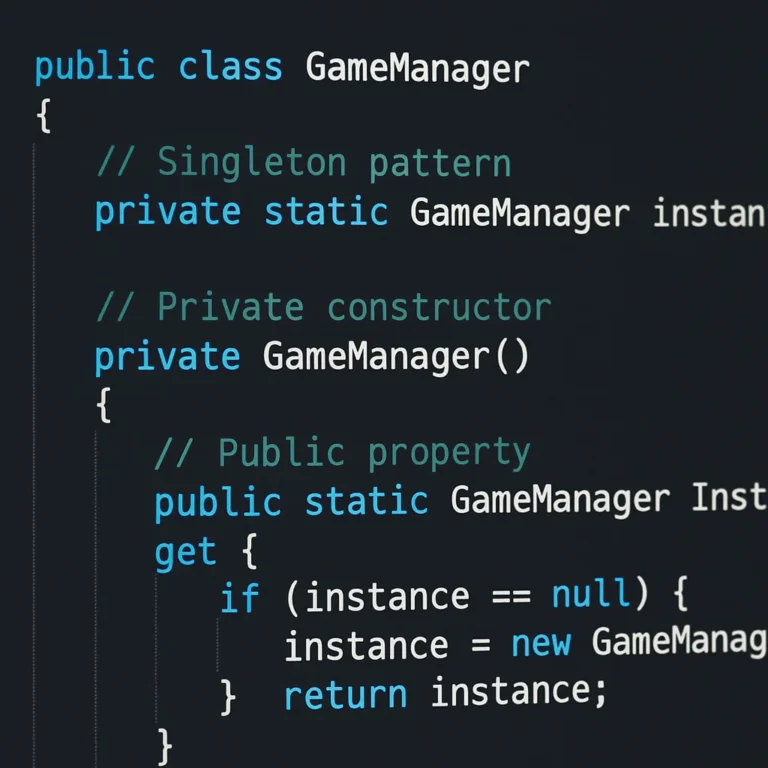
The Singleton Pattern ensures a class has only one instance and provides a global point of access to it. In mobile game dev, this is the most used (and most abused) pattern.
Why We Love It
Imagine you need to access the AudioManager from 50 different scripts. Without a Singleton, you’d have to pass a reference to the AudioManager through every single constructor. With a Singleton, you just call AudioManager.Instance.PlaySound(). It’s convenient, fast, and easy to implement.
The Dark Side
However, as noted in Game Programming Patterns, “many programmers only use the Singleton pattern, leading to poor architecture.”
- Hidden Dependencies: It’s hard to tell which parts of your code rely on the Singleton.
- Testing Nightmares: You can’t easily mock a Singleton in unit tests.
- Global State Issues: If one part of the game changes the Singleton’s state, it might break something else unexpectedly.
The Stack Interface™ Recommendation
Use Singletons only for truly global, stateless, or read-only services like InputManager, AudioManager, or NetworkManager. For game logic, prefer Dependency Injection or Service Locator patterns.
Implementation Tip: In C# (Unity), use a static property with a lazy initialization check to ensure thread safety, though mobile games are mostly single-threaded.
🔄 2. The Observer Pattern: Decoupling Events for Smooth Mobile Performance
The Observer Pattern (often implemented as the Event System or Pub/Sub in game engines) allows an object (the Subject) to notify a list of observers (listeners) about changes in its state.
The Problem It Solves
In a mobile game, your Player might need to update the UI, trigger an Achievement, and play a Sound when they pick up a coin.
- Without Observer: The
Playerscript has to know aboutUI,Achievement, andSoundsystems. This creates tight coupling. - With Observer: The
Playerjust says “CoinColected!” and walks away. The other systems listen and react.
Real-World Example
In Unity, this is often done via UnityEvent or custom C# events. In Unreal, it’s the Event Dispatcher.
| Feature | Direct Method Calls | Observer Pattern |
|---|---|---|
| Coupling | High (Tight) | Low (Lose) |
| Maintainability | Low | High |
| Debuging | Easy (Stack trace is clear) | Harder (Events can be missed) |
| Performance | Fast (Direct call) | Slight overhead (List iteration) |
Warning: Overusing the Observer pattern can lead to “spaghetti events” where you don’t know who is listening to what. Always document your events!
🎮 3. The State Pattern: Handling Complex Player Actions and UI Flows
As discussed in the Unity forums, the State Machine is “super common” and “super useful” for managing game states. Whether it’s a character switching between Idle, Run, Jump, and Attack, or the game transitioning from Menu to Level to GameOver, the State Pattern is the gold standard.
Why It’s Essential for Mobile
Mobile games often have complex UI flows. A user might be in a Shop, then a Sub-Shop, then a PurchaseConfirmation. Without a state machine, you end up with nested if/else statements that are impossible to debug.
Implementation Strategies
- Enum-Based State Machines: Simple, but can become messy with many states.
- Class-Based State Machines: Each state is a class. This is the most flexible and scalable approach.
- Visual State Machines: Tools like Unity Mecanim or Unreal State Machines allow you to visualize transitions.
“Not every problem in Game Design can be reduced to a simple state machine.” — Unity Discussions
While state machines are great for AI and Animation, they aren’t a silver bullet. For complex AI behaviors, consider Behavior Trees instead.
📦 4. The Factory Pattern: Instantiating Assets and Enemies Efficiently
The Factory Pattern provides an interface for creating objects in a superclass, but allows subclasses to alter the type of objects that will be created.
The Mobile Context
In mobile games, you often need to spawn different types of enemies, power-ups, or projectiles based on the level or difficulty.
- Without Factory: You use
if (type == 1) Instantiate(Sword); else if (type == 2) Instantiate(Axe);. - With Factory: You call
EnemyFactory.CreateEnemy(type).
Benefits
- Scalability: Adding a new enemy type doesn’t require modifying the spawning logic, just the factory.
- Encapsulation: The spawning logic is hidden away.
Advanced Variant: The Abstract Factory
If you need to create families of related objects (e.g., a “Desert” set of enemies vs. an “Ice” set), the Abstract Factory pattern is your go-to.
🚀 5. The Command Pattern: Building Robust Input Systems and Undo Mechanics
The Command Pattern encapsulates a request as an object, thereby letting you parameterize clients with queues, requests, and operations.
Why Mobile Games Need It
- Input Handling: Instead of having your
InputManagerdirectly callPlayer.Move(), it creates aMoveCommandobject. This allows you to easily remap controls, record inputs for replays, or even simulate AI inputs. - Undo/Redo: Essential for puzzle games or strategy games. You can push commands onto a stack and pop them to undo actions.
The “Input System” in Unity
Unity’s new Input System package heavily utilizes the Command Pattern under the hood, allowing for complex action mapping and rebinding.
🧩 6. The Strategy Pattern: Swapping AI Behaviors and Level Logic on the Fly
The Strategy Pattern defines a family of algorithms, encapsulates each one, and makes them interchangeable.
Use Case: AI Behaviors
Imagine an enemy that can switch between Patrol, Chase, and Attack strategies based on the player’s distance.
- Without Strategy: A giant
if/elseblock inside the enemy script. - With Strategy: The enemy has a
currentStrategyproperty. You swap the strategy object at runtime.
This is particularly useful for mobile games where you might want to adjust difficulty dynamically without changing the core code.
🛡️ 7. The Object Pool Pattern: Eliminating Garbage Collection Stutters
If there is one pattern that can save your mobile game from crashing, it’s the Object Pool Pattern.
The Problem
In languages like C# (Unity) or Java, creating and destroying objects frequently triggers the Garbage Collector (GC). On mobile, a GC spike can cause a frame drop of 10ms or more, ruining the user experience.
The Solution
Instead of new and destroy, you create a pool of objects at the start of the game. When you need an object, you activate it from the pool. When you’re done, you deactivate it and return it to the pool.
Real-World Application
- Projectiles: Bulets, lasers, and spells.
- Particles: Explosions and effects.
- Enemies: Spawning waves of enemies.
Pro Tip: Always pre-warm your pools. Don’t wait until the first bullet is fired to create the pool.
🧱 8. The Component Pattern: Building Flexible Entities in Unity and Unreal
The Component Pattern (or Entity-Component-System, ECS) is the backbone of modern game engines like Unity and Unreal.
How It Works
Instead of creating a massive Player class that inherits from Enemy, NPC, and Vehicle, you compose entities from small, reusable components:
TransformComponent(Position/Rotation)RigidbodyComponent(Physics)HealthComponent(Life)InputComponent(Controls)
Why It’s Great for Mobile
- Memory Efficiency: You only allocate memory for the components an entity actually needs.
- Flexibility: You can turn a “Car” into a “Flying Car” just by adding a
FlightComponent.
🌐 9. The Flyweight Pattern: Optimizing Memory for Massive Mobile Worlds
The Flyweight Pattern minimizes memory usage by sharing as much data as possible with other similar objects.
The Scenario
Imagine a mobile game with 1,0 trees. If each tree has its own texture, mesh, and material, you’ll run out of RAM instantly.
- Without Flyweight: 1,0 unique objects.
- With Flyweight: 1 shared mesh and texture, plus 1,0 lightweight objects that just store the position and rotation.
Implementation
In Unity, this is often handled automatically by the engine’s rendering pipeline (instancing), but understanding the concept helps when optimizing custom systems.
📉 10. The Memento Pattern: Saving Progress and Checkpoints Reliably
The Memento Pattern captures and externalizes an object’s internal state so that the object can be restored to this state later.
Why It Matters
Mobile players expect to save their progress. Whether it’s a checkpoint in a level or a full save file, you need to serialize the state of your game.
- The Memento: The saved data (often a JSON or binary blob).
- The Caretaker: The
SaveManagerthat stores the memento.
Tip: Always validate your save data. A corrupted save file can brick a player’s progress, leading to bad reviews.
🔍 1. The Visitor Pattern: Extending Functionality Without Modifying Core Code
The Visitor Pattern allows you to add new operations to existing class hierarchies without modifying them.
Use Case
Imagine you have a hierarchy of Enemy types (Goblin, Orc, Dragon). You want to add a new feature: “Calculate Damage Taken by Fire.”
- Without Visitor: You have to modify every enemy class to add a
TakeFireDamage()method. - With Visitor: You create a
FireDamageVisitorthat visits each enemy and applies the logic.
This adheres to the Open/Closed Principle: open for extension, closed for modification.
⚖️ Comparing Design Patterns: When to Use Which in Mobile Development
Choosing the right pattern is like choosing the right tool for a job. Here is a quick reference guide:
| Pattern | Best Use Case | Mobile Performance Impact | Complexity |
|---|---|---|---|
| Singleton | Global Managers (Audio, Input) | Low (if used sparingly) | Low |
| Observer | Event systems, UI updates | Medium (event iteration) | Medium |
| State | AI, Animation, Game Flow | Low | Medium |
| Factory | Object creation, Spawning | Low | Low |
| Command | Input, Undo/Redo | Low | Medium |
| Strategy | AI Behaviors, Algorithms | Low | Medium |
| Object Pool | Projectiles, Particles | High (Critical) | Medium |
| Component | Entity composition | Low (if optimized) | High |
| Flyweight | Massive object counts | High (Critical) | High |
| Memento | Save/Load systems | Low | Medium |
🛠️ Common Pitfalls: Anti-Patterns That Will Crash Your Mobile Game
Even the best patterns can be misused. Here are the anti-patterns we see too often in mobile dev:
- God Object: A single class that does everything (Input, Physics, AI, UI). This is the death of maintainability.
- Over-Engineering: Using a Factory for a simple
Instantiatecall. Don’t use a sledgehammer to crack a nut. - Global State Abuse: Using Singletons for everything. This makes your code impossible to test.
- Memory Leaks: Forgetting to unsubscribe from Observer events. This is a common cause of crashes in long-running mobile sessions.
- Ignoring the GC: Creating new objects in
Update()loops. This will kill your frame rate.
Remember: “Tricks for shaving off cycles can mean the difference between an A-rated game and millions of sales or dropped frames and angry reviewers.” — Game Programming Patterns
🎓 Learning Resources: Books, Courses, and Community Discussions
If you want to master these patterns, here are the resources we at Stack Interface™ swear by:
- Books:
Game Programming Patterns by Robert Nystrom (Free online, essential reading).
Design Patterns: Elements of Reusable Object-Oriented Software by the Gang of Four (The classic).
Unity in Action by Joseph Hocking. - Courses:
Udemy: Complete C# Unity Game Developer 3D.
Coursera: Game Design and Development Specialization. - Community:
Unity Forums: Great for specific implementation questions.
Stack Overflow: For debugging specific code issues.
Reddit: r/gamedev and r/Unity3D.
For more on AI in Software Development and how it’s changing game logic, check out our article on AI in Software Development.
✅ Conclusion

Choosing the right design patterns for your mobile game isn’t just about writing “clean code”; it’s about ensuring your game runs smoothly on a device that might be in a user’s pocket, running hot, and on a shaky connection.
We’ve explored the Singleton for global access, the Observer for decoupled communication, the State Machine for complex flows, and the Object Pool for performance. But the real secret isn’t in picking one “best” pattern. It’s in knowing when to use each one.
As we mentioned earlier, the State Machine is “super useful” for managing game states, but it’s not a cure-all. The Object Pool is critical for mobile performance, but it adds complexity. The Singleton is convenient, but dangerous if overused.
The best mobile games are built on a hybrid architecture that leverages the strengths of multiple patterns while avoiding their pitfalls. Whether you are building a casual puzzle game or a massive open-world RPG, the principles remain the same: decouple your systems, manage your memory, and keep your code modular.
So, the next time you sit down to code that next hit mobile game, ask yourself: “Am I solving this problem with a hammer, or do I need a screwdriver?” Choose your pattern wisely, and your players will thank you with 5-star reviews and long play sessions.
🔗 Recommended Links
If you’re ready to start building or need the right tools for the job, here are our top picks:
👉 Shop Game Development Books on:
- Game Programming Patterns: Amazon | Official Website
- Design Patterns: Elements of Reusable Object-Oriented Software: Amazon | Addison-Wesley
👉 Shop Game Engines & Tools on:
- Unity Engine: Unity Official Site | Unity Asset Store
- Unreal Engine: Unreal Engine Official Site | Unreal Marketplace
👉 Shop Hardware for Development on:
- Mobile Development Devices: Amazon Search for Android Tablets | Apple Developer Site
📚 Reference Links
- Game Programming Patterns: gameprogrammingpatterns.com
- Unity State Machine Discussion: Unity Forums – State Machine Suitability
- Design Patterns for Programming in Unity (Jason Tutle): Medium Article
- Gang of Four Book: Design Patterns: Elements of Reusable Object-Oriented Software
- Unity Documentation – Scriptable Objects: Unity Scriptable Objects
- Unreal Engine – Event Dispatchers: Unreal Event Dispatchers
FAQ

What are the most common design patterns used in Unity mobile games?
The most common patterns in Unity mobile games are the Singleton, Observer (Event System), State Machine, Object Pool, and Component patterns. These patterns address the specific needs of mobile development: managing global state, decoupling systems, handling complex flows, optimizing memory, and building flexible entities.
Read more about “🚀 7 Benefits of Design Patterns in App & Game Dev (2026)”
How does the Singleton pattern impact mobile game performance?
The Singleton pattern itself has a negligible performance impact if used correctly. However, overusing it can lead to tight coupling, making code harder to maintain and test. In terms of memory, a Singleton is just one instance, so it doesn’t bloat memory, but the dependencies it creates can lead to hidden memory leaks if not managed properly.
Read more about “🚫 15 Deadly Anti-Patterns to Dodge in App & Game Dev (2026)”
When should I use the Observer pattern in mobile game development?
You should use the Observer pattern whenever you need to decouple two systems that need to communicate but shouldn’t know about each other. Common use cases include:
- UI updates triggered by game events.
- Achievement systems reacting to player actions.
- Audio systems playing sounds based on in-game events.
- Network systems syncing state changes.
Read more about “⚠️ Yes, Design Patterns Can Destroy Your Game (2026 Guide)”
Which design patterns help reduce memory usage in mobile games?
The Object Pool pattern is the most effective for reducing memory usage and preventing Garbage Collection spikes. The Flyweight pattern is also crucial for reducing memory when dealing with large numbers of similar objects (like trees or particles). Additionally, the Component pattern helps by only allocating memory for the specific components an entity needs.
Read more about “🧱 15+ Design Patterns for Reusable Apps & Games (2026)”
Can the Factory pattern simplify mobile game asset management?
Yes, the Factory pattern simplifies asset management by centralizing the creation logic. Instead of scattering Instantiate calls throughout your code, you use a factory to create objects. This makes it easier to swap out assets, implement object pooling, and manage different variations of objects (e.g., different enemy types) without modifying the core spawning logic.
How does the State pattern improve mobile game UI responsiveness?
The State pattern improves UI responsiveness by ensuring that UI transitions are handled cleanly and predictably. Instead of having a tangled web of if/else statements to show/hide UI elements, a state machine ensures that only the relevant UI for the current state is active. This reduces the risk of bugs and makes the UI feel more snappy and responsive.
Read more about “🎮 8 Real-World Design Patterns Powering Your Favorite Games (2026)”
What design patterns are best for handling mobile game input systems?
The Command pattern is best for handling mobile game input systems. It encapsulates input actions as objects, allowing for easy remapping, recording, and simulation. This is particularly useful for mobile games where touch controls might need to be dynamically adjusted or where you need to support multiple input methods (touch, controller, keyboard).
Why is the Object Pool pattern critical for mobile performance?
Mobile devices have limited memory and processing power. Creating and destroying objects frequently triggers the Garbage Collector, which can cause frame drops. The Object Pool pattern reuses objects, eliminating the need for frequent allocation and dealocation, thus ensuring a smooth, stutter-free experience.
How do I decide between a State Machine and a Behavior Tree for AI?
Use a State Machine for simple, predictable AI behaviors (e.g., patrol, chase, attack). Use a Behavior Tree for complex, dynamic AI that needs to make decisions based on multiple factors (e.g., a boss that adapts to the player’s strategy). State machines are easier to implement and debug, while Behavior Trees offer more flexibility and scalability.