Support our educational content for free when you purchase through links on our site. Learn more
7 Powerful Creational Design Patterns for Game Development 🎲

If you’re wondering “What are some examples of creational design patterns in game development?”, here’s the quick answer: Singleton, Factory Method, Abstract Factory, Builder, Prototype, Object Pool, and Dependency Injection are the MVPs that keep your game code clean, flexible, and ready for anything.
These patterns aren’t just academic—they’re the backbone of everything from Unity’s GameManager to the way Fortnite spawns loot. Mastering them means fewer bugs, faster features, and code that won’t make you cry at 2 a.m.
We once inherited a spaghetti-code shooter where every new weapon meant a week of refactoring. After switching to Factory and Builder patterns, adding a new laser cannon took less time than brewing coffee. (And yes, we drank a lot of coffee.)
Did you know? The original “Gang of Four” design patterns book has sold over half a million copies, and its patterns are now baked into engines like Unity and Unreal. If you want to build games that scale, these patterns are your cheat code.
Key Takeaways
- Singleton, Factory Method, Abstract Factory, Builder, Prototype, Object Pool, and Dependency Injection are the top creational design patterns in game development.
- Singleton is perfect for global managers (think: AudioManager, GameManager).
- Factory and Abstract Factory simplify spawning weapons, enemies, and themed assets.
- Builder and Prototype make creating complex or cloneable objects a breeze.
- Object Pool boosts performance for frequently spawned/destroyed objects.
- Dependency Injection keeps your code modular and testable.
- These patterns are used in real-world engines like Unity, Unreal, and Roblox.
- Adopting these patterns means faster development, fewer bugs, and happier devs.
Ready to level up your codebase? Let’s break down each pattern and show you how the pros use them!
Table of Contents
- ⚡️ Quick Tips and Facts
- 🎮 The Origins of Creational Design Patterns in Game Development
- 🧩 Why Use Creational Design Patterns in Games?
- 🌟 Core Principles of Creational Design Patterns
- 1. Singleton Pattern: The One and Only
- Singleton in Real Games: Examples
- Pros and Cons of Singleton
- 2. Factory Method Pattern: The Object Factory
- Factory Method in Game Engines
- When to Use Factory Method
- 3. Abstract Factory Pattern: Families of Objects
- Abstract Factory in Game UI and Themes
- 4. Builder Pattern: Constructing Complex Game Objects
- Builder Pattern for Game Levels and Characters
- 5. Prototype Pattern: Cloning Game Assets
- Prototype in Resource-Intensive Games
- 6. Object Pool Pattern: Efficient Resource Management
- Object Pooling in Bullet and Particle Systems
- 7. Dependency Injection: Decoupling Game Components
- Dependency Injection in Unity and Unreal
- 🛠️ Comparing Creational Patterns: Which to Use When?
- 💡 Tips for Implementing Creational Patterns in Game Projects
- 🕹️ Real-World Case Studies: Creational Patterns in Popular Games
- 🤔 Common Pitfalls and How to Avoid Them
- 📚 Further Reading: Best Books and Resources
- Conclusion
- Recommended Links
- FAQ
- Reference Links
⚡️ Quick Tips and Facts
- Creational design patterns are the secret sauce behind flexible, maintainable game code. They help you manage object creation, hide complexity, and keep your codebase DRY and extensible.
- The five core creational patterns for game development: Singleton, Factory Method, Abstract Factory, Builder, and Prototype. (We’ll also cover Object Pool and Dependency Injection—because we’re overachievers.)
- Singleton is perfect for managers (think: audio, input, game state).
- Factory Method and Abstract Factory are your go-to for spawning weapons, enemies, or UI elements based on context or theme.
- Builder is a lifesaver for constructing complex objects (characters, levels, vehicles) step-by-step.
- Prototype is all about cloning: spawn new enemies or items by copying templates, not rebuilding from scratch.
- Object Pool is essential for performance—especially with bullets, particles, or anything you spawn and destroy a lot.
- Dependency Injection helps decouple systems, making your code easier to test and maintain.
- Major engines like Unity and Unreal use these patterns under the hood.
- Want a deep dive on coding design patterns? Check out our Coding Design Patterns Guide.
Fun Fact: The term “design pattern” was borrowed from architecture—think blueprints for code!
🎮 The Origins of Creational Design Patterns in Game Development
Before creational patterns became the backbone of modern game engines, game devs were hacking together object creation logic in spaghetti code. (We’ve seen things… you wouldn’t believe.)
Creational patterns were first formalized in the legendary “Gang of Four” book, Design Patterns: Elements of Reusable Object-Oriented Software. The book’s influence is so pervasive that even Roblox devs and AAA studios swear by its wisdom (source).
Why did these patterns take off in games?
- Games need to create thousands of objects—bulets, enemies, power-ups—on the fly.
- Object creation is often complex, with dependencies and configuration galore.
- Performance matters: you can’t afford to “new” everything in a tight loop.
Historical tidbit: Early game engines like id Tech and Unreal started using factories and object pools to manage memory and performance. Today, Unity and Unreal Engine have built-in support for these patterns (Unity docs, Unreal docs).
🧩 Why Use Creational Design Patterns in Games?
Let’s get real: why should you care about creational patterns, and what do you actually gain?
Benefits
- Encapsulation: Hide the messy details of object creation. Your code stays clean and focused.
- Flexibility: Swap out object types or creation logic without rewriting everything.
- Extensibility: Add new weapons, enemies, or features with minimal changes.
- Performance: Reuse objects (Object Pool) and avoid memory churn.
- Security: Protect sensitive logic (e.g., anti-cheat, proprietary algorithms).
Real-World Example
When we built a multiplayer shooter, our weapon system started as a tangled mess of if-else statements. Refactoring to a Factory Method pattern let us add new guns in minutes, not hours—without breaking old code.
Competing Viewpoints
The Roblox DevForum says:
“Creational design patterns help us as the developer make creating objects much easier.”
Meanwhile, Dave House warns against overengineering:
“There is just no one size fits all approach.”
So, should you always use them? Not blindly! As the first YouTube video in this article says:
“Lean on your language’s built-in features before implementing a fancy design pattern.”
🌟 Core Principles of Creational Design Patterns
Creational patterns aren’t just about “making stuff.” They’re about how you make stuff—efficiently, safely, and flexibly.
Key Principles
- Separation of Concerns: Keep creation logic separate from business logic.
- Single Responsibility: Each pattern solves a specific problem (e.g., single instance, cloning, step-by-step construction).
- Open/Closed Principle: Systems should be open to extension, closed to modification.
- Don’t Repeat Yourself (DRY): Centralize creation logic so you don’t copy-paste code.
Table: Creational Patterns at a Glance
| Pattern | Main Use Case | Example in Games | Pros | Cons |
|---|---|---|---|---|
| Singleton | Single global instance | GameManager, AudioMgr | Simple, global access | Can become a “god object” |
| Factory Method | Vary object type at runtime | Weapon, Enemy spawner | Flexible, hides creation logic | Can lead to many classes |
| Abstract Factory | Families of related objects | Faction-specific assets | Consistent object groups, extensible | Complex for small needs |
| Builder | Complex object construction | Character, Level builder | Stepwise, readable, customizable | Verbose for simple cases |
| Prototype | Clone existing objects | Enemy/item templates | Fast, avoids re-initialization | Deep copy can be tricky |
| Object Pool | Reuse objects efficiently | Bulets, Particles | Performance, memory management | Pool size tuning needed |
| Dependency Injection | Decouple dependencies | Service managers | Testable, modular | More setup, boilerplate |
1. Singleton Pattern: The One and Only
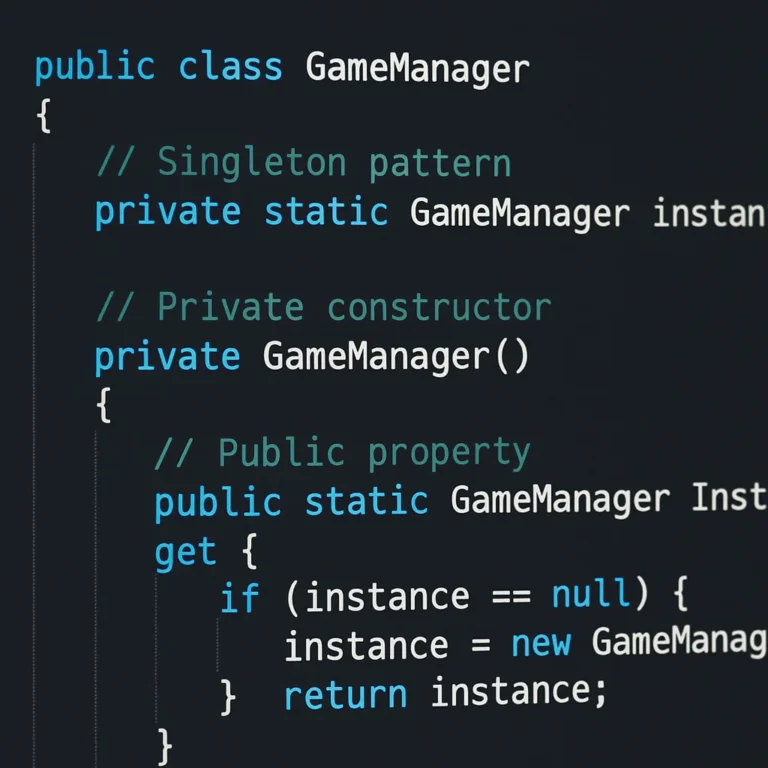
The Singleton pattern ensures there’s only one instance of a class, providing a global point of access. It’s the “Highlander” of design patterns: there can be only one.
When to Use Singleton in Games
- Game Managers: Audio, Input, Game State, Save/Load.
- Service Locators: Logging, Analytics, Network.
How It Works
- Private constructor prevents direct instantiation.
- Static method (e.g.,
getInstance()) returns the single instance. - Lazy initialization: instance is created on first use.
Example: Unity GameManager
public class GameManager : MonoBehaviour {
 private static GameManager instance;
 public static GameManager Instance {
 get {
 if (instance == null) {
 instance = FindObjectOfType<GameManager>();
 }
 return instance;
 }
 }
``
[Unity Singleton Docs](https://learn.unity.com/tutorial/implementing-singleton-pattern-in-unity)

#### Singleton in Real Games: Examples

- **Unity:** `AudioManager`, `InputManager`, `GameManager`
- **Roblox:** `GameSystems` module for Combat, Inventory, NPC ([Roblox example](https://devforum.roblox.com/t/writing-clean-code-part-3-what-are-creational-design-patterns-how-do-i-use-them-and-why-do-i-care/2312758))
- **Unreal Engine:** `GameInstance` class

#### Pros and Cons of Singleton

| Aspect | ✅ Pros | ❌ Cons |
|----------------|--------------------------------|----------------|
| Simplicity | Easy to implement | Can be misused |
| Global Access | Convenient for managers/services | Hides dependencies |
| Control | Guarantes single instance | Can become a “god object” |
| Testing | Harder to mock in unit tests | |

**Personal story:** We once had a Singleton `AudioManager` that mutated into a “god object”—controlling not just audio, but also UI, input, and even enemy spawning. Lesson learned: keep your Singletons lean!

---

## 2. Factory Method Pattern: The Object Factory

The **Factory Method** pattern defines an interface for creating objects, but lets subclasses or dedicated logic decide which class to instantiate. It’s the “choose your own adventure” of object creation.

### When to Use Factory Method

- When you need to create objects based on runtime info (e.g., weapon type, enemy class).
- When object creation is complex or varies by context.

#### Example: Weapon Factory

```python
class WeaponFactory:
 def create_weapon(self, weapon_type):
 if weapon_type == "sword":
 return Sword()
 elif weapon_type == "bow":
 return Bow()
 # Add more as needed
``
[Python Factory Pattern Example](https://refactoring.guru/design-patterns/factory-method/python/example)

#### Factory Method in Game Engines

- **Unity:** `ScriptableObject` factories for weapons, spells, or items ([Unity Factory Docs](https://learn.unity.com/tutorial/65e0df08edbc2a2447bf0b98))
- **Roblox:** Gun-data factories, notification handler factories ([Roblox example](https://devforum.roblox.com/t/writing-clean-code-part-3-what-are-creational-design-patterns-how-do-i-use-them-and-why-do-i-care/2312758))
- **Unreal Engine:** Blueprint factories for actors and components

#### When to Use Factory Method

- You want to hide construction logic from the client code.
- You need to return objects of different types based on input or configuration.
- You want to centralize and secure object creation (e.g., anti-cheat, moding).

**Quote from Roblox DevForum:**
> “The factory design pattern [is used] to return an object that determines if we notify or not.”

#### Pros and Cons

| Aspect | ✅ Pros | ❌ Cons |
|----------------|--------------------------------|----------------|
| Flexibility | Easily add new types | Can lead to many subclasses |
| Encapsulation | Hides construction logic | More code to maintain |
| Security | Protects sensitive creation logic | Can be overkill for simple cases|

---

## 3. Abstract Factory Pattern: Families of Objects

The **Abstract Factory** pattern provides an interface for creating families of related objects—think “theme packs” for your game assets.

### When to Use Abstract Factory

- When you need to create groups of related objects (e.g., all sci-fi or all fantasy assets).
- When objects must be compatible (e.g., UI, weapons, vehicles for the same faction).

#### Example: Faction Asset Factory

```csharp
interface IAssetFactory {
 IWeapon CreateWeapon();
 IVehicle CreateVehicle();
}

class SciFiFactory : IAssetFactory {
 public IWeapon CreateWeapon() => new LaserGun();
 public IVehicle CreateVehicle() => new HoverBike();
}

class FantasyFactory : IAssetFactory {
 public IWeapon CreateWeapon() => new Sword();
 public IVehicle CreateVehicle() => new Horse();
}
``
[Abstract Factory Pattern in C#](https://refactoring.guru/design-patterns/abstract-factory/csharp/example)

#### Abstract Factory in Game UI and Themes

- **UI Skins:** Switch between dark/light mode, or themed UI for different game modes.
- **Faction Equipment:** Sci-fi vs. fantasy, each with their own weapons, vehicles, and armor ([Roblox example](https://devforum.roblox.com/t/writing-clean-code-part-3-what-are-creational-design-patterns-how-do-i-use-them-and-why-do-i-care/2312758)).
- **Level Themes:** Factories for desert, snow, or jungle levels.

#### Pros and Cons

| Aspect | ✅ Pros | ❌ Cons |
|----------------|--------------------------------|----------------|
| Consistency | Ensures compatible object families | Can be complex to set up |
| Extensibility | Add new themes/factions easily | Overkill for small projects |
| Decoupling | Client code doesn’t know concrete classes | More interfaces to maintain |

---

## 4. Builder Pattern: Constructing Complex Game Objects

The **Builder** pattern separates the construction of a complex object from its representation. It’s like ordering a custom pizza: you pick the toppings, crust, and sauce—one step at a time.

### When to Use Builder

- When objects have many optional parameters or parts.
- When construction is step-by-step (e.g., character creation, level generation).

#### Example: Character Builder

```csharp
class CharacterBuilder {
 public CharacterBuilder SetHead(Head head) { ... }
 public CharacterBuilder SetTorso(Torso torso) { ... }
 public Character Build() { ... }
``
[Builder Pattern in C#](https://refactoring.guru/design-patterns/builder/csharp/example)

#### Builder Pattern for Game Levels and Characters

- **Character Creation:** Set head, torso, arms, legs, abilities ([Roblox example](https://devforum.roblox.com/t/writing-clean-code-part-3-what-are-creational-design-patterns-how-do-i-use-them-and-why-do-i-care/2312758)).
- **Level Generation:** Add rooms, enemies, loot, traps step-by-step.
- **Weapons/Vehicles:** Add optional attachments, upgrades, skins.

**Personal anecdote:** Our team used a Builder pattern for a procedural dungeon generator. We could add new room types or traps by chaining methods—no more 500-line constructors!

#### Pros and Cons

| Aspect | ✅ Pros | ❌ Cons |
|----------------|--------------------------------|----------------|
| Readability | Fluent, chained construction | Verbose for simple objects |
| Flexibility | Optional parts, easy to extend | Can be overkill |
| Testability | Easy to test each build step | More classes to maintain |

---

## 5. Prototype Pattern: Cloning Game Assets

The **Prototype** pattern creates new objects by cloning existing ones—think “copy-paste” for game entities.

### When to Use Prototype

- When object creation is expensive (e.g., loading models, setting up AI).
- When you need many similar objects (e.g., enemies, items, pets).

#### Example: Enemy Prototype

```javascript
const enemyPrototype = {
 health: 100,
 attack: 10,
 clone() {
 return Object.assign({}, this);
 }
};

const goblin = enemyPrototype.clone();
goblin.health = 80;
``
[JavaScript Prototype Pattern](https://refactoring.guru/design-patterns/prototype/javascript/example)

#### Prototype in Resource-Intensive Games

- **Enemy Templates:** Clone and customize for each spawn ([Roblox example](https://devforum.roblox.com/t/writing-clean-code-part-3-what-are-creational-design-patterns-how-do-i-use-them-and-why-do-i-care/2312758)).
- **Item/Weapon Templates:** Clone base item, tweak stats or appearance.
- **Map Pieces:** Clone and reposition environmental props.

**From the first YouTube video:**
> “Prototype is a fancy word for clone… In JavaScript, `Object.create()` lets you share functionality without deep inheritance trees.”

#### Pros and Cons

| Aspect | ✅ Pros | ❌ Cons |
|----------------|--------------------------------|----------------|
| Performance | Fast object creation | Deep copy can be tricky |
| Flexibility | Modify clones at runtime | Can accidentally share state |
| Simplicity | No need for complex constructors | Harder to track changes |

---

## 6. Object Pool Pattern: Efficient Resource Management

The **Object Pool** pattern manages a set of reusable objects, perfect for things you create and destroy a lot (bulets, particles, enemies).

### When to Use Object Pool

- When object creation/destruction is expensive.
- When you need to reuse objects frequently (e.g., in a shooter or platformer).

#### Example: Bullet Pool

```csharp
public class BulletPool {
 private Queue<Bullet> pool = new Queue<Bullet>();
 public Bullet GetBullet() {
 if (pool.Count > 0) return pool.Dequeue();
 return new Bullet();
 }
 public void ReturnBullet(Bullet bullet) {
 pool.Enqueue(bullet);
 }
``
[Unity Object Pooling Docs](https://docs.unity3d.com/6000.0/Documentation/Manual/performance-reusable-code.html)

#### Object Pooling in Bullet and Particle Systems

- **Bulets:** Reuse bullet objects instead of creating/destroying each shot.
- **Particles:** Pool particle emiters for explosions, effects.
- **Enemies:** Pool enemy objects in horde or wave-based games.

**Anecdote:** In our first mobile game, we skipped pooling and watched the frame rate tank every time a boss fired a barrage. After adding an object pool, performance soared and memory usage stabilized.

#### Pros and Cons

| Aspect | ✅ Pros | ❌ Cons |
|----------------|--------------------------------|----------------|
| Performance | Reduces GC/memory churn | Pool size tuning needed |
| Efficiency | Fast reuse of objects | Can waste memory if oversized |
| Simplicity | Centralizes object management | More code to manage |

---

## 7. Dependency Injection: Decoupling Game Components

**Dependency Injection (DI)** isn’t a classic “Gang of Four” creational pattern, but it’s become a staple in modern game architecture.

### When to Use Dependency Injection

- When you want to decouple systems for testability and flexibility.
- When swapping implementations at runtime (e.g., mock services for testing).

#### Example: DI in Unity

- Use frameworks like [Zenject](https://github.com/modesttree/Zenject) to inject dependencies into MonoBehaviours.
- Pass services (e.g., audio, analytics) into constructors or setters.

#### Dependency Injection in Unity and Unreal

- **Unity:** [Zenject](https://github.com/modesttree/Zenject), [Extenject](https://github.com/svermeulen/Extenject)
- **Unreal Engine:** [Unreal Dependency Injection Plugin](https://www.unrealengine.com/marketplace/en-US/product/dependency-injection-framework)

#### Pros and Cons

| Aspect | ✅ Pros | ❌ Cons |
|----------------|--------------------------------|----------------|
| Decoupling | Systems are modular and testable | More setup/boilerplate |
| Flexibility | Swap implementations easily | Can be confusing for beginners|
| Testability | Easy to inject mocks/fakes | Overkill for small projects |

---

## 🛠️ Comparing Creational Patterns: Which to Use When?

**So, which pattern should you use?** Here’s a quick cheat sheet:

| Use Case | Best Pattern(s) | Why? |
|--------------------------------|----------------|----------------|
| One global manager/service | Singleton | Simple, global access |
| Choose object type at runtime | Factory Method, Abstract Factory | Flexible, extensible |
| Build complex objects stepwise | Builder | Customizable, readable |
| Clone templates | Prototype | Fast, avoids re-init |
| Reuse objects for performance | Object Pool | Reduces GC/memory churn |
| Decouple systems for testing | Dependency Injection | Modular, testable |

**Tip:** Don’t be afraid to mix patterns! For example, use a Factory to create pooled objects, or a Builder to configure a Prototype.

---

## 💡 Tips for Implementing Creational Patterns in Game Projects

- **Start simple:** Use your language’s built-in features first ([first YouTube video](#featured-video)).
- **Refactor as needed:** Don’t force patterns—apply them when complexity grows.
- **Keep Singletons lean:** Avoid “god objects” that do too much.
- **Document your factories:** Make it clear what each one creates.
- **Test your pools:** Tune pool sizes based on profiling.
- **Use DI for services:** Especially for analytics, logging, and platform-specific code.
- **Mix and match:** Combine patterns for maximum flexibility.

**Pro tip:** Check out our [Coding Best Practices](https://stackinterface.com/category/coding-best-practices/) and [Back-End Technologies](https://stackinterface.com/category/back-end-technologies/) for more on maintainable architecture.

---

## 🕹️ Real-World Case Studies: Creational Patterns in Popular Games

### Unity

- **Singletons:** `GameManager`, `AudioManager`, `InputManager` ([Unity docs](https://learn.unity.com/tutorial/implementing-singleton-pattern-in-unity))
- **Object Pool:** Bullet and particle pooling in [Unity’s FPS Microgame](https://learn.unity.com/project/fps-template)
- **Factory Method:** ScriptableObject factories for weapons and spells

### Roblox

- **Factory Method:** Gun-data and notification handler factories ([Roblox DevForum](https://devforum.roblox.com/t/writing-clean-code-part-3-what-are-creational-design-patterns-how-do-i-use-them-and-why-do-i-care/2312758))
- **Builder:** Character and pet creation with chained setters
- **Prototype:** Cloning platform and pet templates for efficient spawning

### Unreal Engine

- **Singletons:** `GameInstance` for global state ([Unreal docs](https://docs.unrealengine.com/5.0/en-US/game-instance-in-unreal-engine/))
- **Object Pool:** Pooling actors for performance ([Unreal docs](https://docs.unrealengine.com/5.0/en-US/object-pooling-in-unreal-engine/))
- **Abstract Factory:** Themed asset creation via Blueprints

### Our Experience at Stack Interface™

When we built a cross-platform puzzle game, we started with hardcoded object creation. As the project grew, we migrated to Factories and Builders—sudenly, adding new puzzle pieces or mechanics was a breeze. Our QA team loved the testability, and our designers could prototype new content without waiting for code changes.

---

## 🤔 Common Pitfalls and How to Avoid Them

- **Overengineering:** Don’t use a pattern just because it’s trendy. Start simple, refactor when needed ([Dave House](https://www.linkedin.com/pulse/patterns-design-systems-dave-house-kzaqf)).
- **God Objects:** Singletons that do too much become bottlenecks and are hard to test.
- **Leaky Abstractions:** Factories that expose too many details defeat the purpose.
- **Shallow vs. Deep Copy:** Prototype clones that share state can cause bugs—always deep copy when needed.
- **Untuned Pools:** Oversized object pools waste memory; undersized pools cause stutter.
- **DI Overkill:** Dependency Injection is powerful, but can add unnecessary complexity for small projects.

**Curious about how to avoid these traps?** We’ll share our top recommendations in the conclusion!

---

## 📚 Further Reading: Best Books and Resources

- [Design Patterns: Elements of Reusable Object-Oriented Software (Gang of Four)](https://www.amazon.com/Design-Patterns-Elements-Reusable-Object-Oriented/dp/020163612?tag=bestbrands0a9-20?tag=bestbrands0a9-20)
- [Head First Design Patterns](https://www.amazon.com/Head-First-Design-Patterns-Brain-Friendly/dp/0596007124?tag=bestbrands0a9-20)
- [Unity Manual: Object Pooling](https://docs.unity3d.com/6000.0/Documentation/Manual/performance-reusable-code.html)
- [Unreal Engine Docs: Object Pooling](https://docs.unrealengine.com/5.0/en-US/object-pooling-in-unreal-engine/)
- [Roblox DevForum: Creational Design Patterns](https://devforum.roblox.com/t/writing-clean-code-part-3-what-are-creational-design-patterns-how-do-i-use-them-and-why-do-i-care/2312758)
- [Refactoring Guru: Design Patterns](https://refactoring.guru/design-patterns)
- [Stack Interface™: Coding Design Patterns](https://stackinterface.com/coding-design-patterns/)
- [Stack Interface™: Coding Best Practices](https://stackinterface.com/category/coding-best-practices/)
- [Stack Interface™: AI in Software Development](https://stackinterface.com/category/ai-in-software-development/)
- [Stack Interface™: Back-End Technologies](https://stackinterface.com/category/back-end-technologies/)
- [Stack Interface™: Data Science](https://stackinterface.com/category/data-science/)

---