Support our educational content for free when you purchase through links on our site. Learn more
Stack vs Queue 🤔

In the world of data structures, two fundamental concepts have been debated for years: stacks and queues. As a developer, understanding the differences between these two data structures is crucial for efficient programming solutions. But what exactly are stacks and queues, and how do they differ? In this article, we’ll delve into the world of stacks and queues, exploring their definitions, use cases, and key differences. We’ll also examine real-world applications, implementation strategies, and common pitfalls to watch out for. So, if you’re ready to learn about the ultimate showdown between stacks and queues, keep reading!
As we explore the realm of stacks and queues, you’ll discover that these data structures are not just abstract concepts, but have real-world implications. For instance, did you know that stacks are used in undo mechanisms, while queues are used in task scheduling? Or that queues are essential in breadth-first search algorithms? We’ll dive into these topics and more, providing you with a comprehensive understanding of stacks and queues. But first, let’s take a look at the key takeaways from this article.
Key Takeaways
- Stacks follow the LIFO principle, while queues follow the FIFO principle
- Real-world applications of stacks and queues include undo mechanisms, task scheduling, and breadth-first search algorithms
- Implementation strategies include using arrays, linked lists, and dynamic memory allocation
To learn more about data structures and algorithms, visit our Data Science category. For more information on coding best practices, check out our Coding Best Practices category.
Table of Contents
⚡️ Quick Tips and Facts
📚 Introduction to Data Structures: Stacks and Queues
🔙 History of Stack and Queue Data Structures
📊 Types of Stacks
📝 Types of Queues
🤔 Understanding Stacks
1. Last-In-First-Out (LIFO) Principle
2. Stack Operations
📄 Understanding Queues
1. First-In-First-Out (FIFO) Principle
2. Queue Operations
📊 Key Differences Between Stack and Queue
1. Order of Removal
2. Accessing Elements
📈 Real-World Applications of Stacks and Queues
1. Stack Applications
2. Queue Applications
📝 Implementing Stacks and Queues in Programming
1. Using Arrays
2. Using Linked Lists
🤝 Comparison of Stack and Queue Implementations
📊 Time and Space Complexity Analysis
📝 Common Errors and Pitfalls
📚 Best Practices for Using Stacks and Queues
🎉 Conclusion
🔗 Recommended Links
🤔 FAQ
📚 Reference Links
Quick Tips and Facts
As developers and software engineers at Stack Interface, we’ve worked with various data structures, and we can tell you that understanding the differences between stacks and queues is crucial for efficient programming solutions. Here are some quick tips and facts to get you started:
- Stacks follow the Last-In-First-Out (LIFO) principle, while queues follow the First-In-First-Out (FIFO) principle.
- Stacks are useful for backtracking, function call management, and expression evaluation, whereas queues are suited for task scheduling, resource management, and breadth-first search algorithms.
- You can implement stacks and queues using arrays or linked lists, and both data structures have their own set of operations and use cases.
Introduction to Data Structures: Stacks and Queues

Data structures are the foundation of any programming language, and stacks and queues are two of the most fundamental data structures. A stack is a linear data structure that follows the LIFO principle, where elements are added and removed from the top. On the other hand, a queue is a linear data structure that follows the FIFO principle, where elements are added to the rear and removed from the front. To learn more about data structures, visit our Data Science category.
History of Stack and Queue Data Structures

The concept of stacks and queues has been around for decades, and they have been used in various programming languages and applications. The first stack-based algorithm was developed in the 1940s, and since then, stacks and queues have become an essential part of computer science. For more information on the history of data structures, check out this article on GeeksforGeeks.
Types of Stacks
There are several types of stacks, including:
- Array-based stacks: These stacks use arrays to store elements and are suitable for small to medium-sized datasets.
- Linked list-based stacks: These stacks use linked lists to store elements and are suitable for large datasets.
- Dynamic stacks: These stacks can grow or shrink dynamically as elements are added or removed.
Types of Queues
There are several types of queues, including:
- Array-based queues: These queues use arrays to store elements and are suitable for small to medium-sized datasets.
- Linked list-based queues: These queues use linked lists to store elements and are suitable for large datasets.
- Circular queues: These queues use a circular array to store elements and are suitable for applications where the queue is constantly being updated.
Understanding Stacks
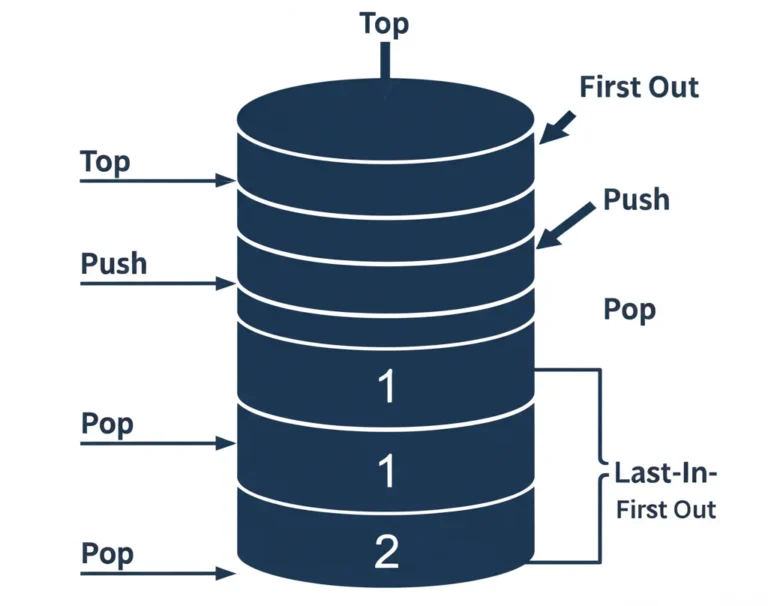
A stack is a linear data structure that follows the LIFO principle. Here are some key points to understand about stacks:
Last-In-First-Out (LIFO) Principle
The LIFO principle states that the last element added to the stack is the first one to be removed. This principle is the foundation of stack operations.
Stack Operations
Stack operations include:
- Push: Adds an element to the top of the stack.
- Pop: Removes the top element from the stack.
- Peek: Returns the top element of the stack without removing it.
- IsEmpty: Checks if the stack is empty.
- Size: Returns the number of elements in the stack.
Understanding Queues
A queue is a linear data structure that follows the FIFO principle. Here are some key points to understand about queues:
First-In-First-Out (FIFO) Principle
The FIFO principle states that the first element added to the queue is the first one to be removed. This principle is the foundation of queue operations.
Queue Operations
Queue operations include:
- Enqueue: Adds an element to the rear of the queue.
- Dequeue: Removes the front element from the queue.
- Front: Returns the front element of the queue without removing it.
- IsEmpty: Checks if the queue is empty.
- Size: Returns the number of elements in the queue.
Key Differences Between Stack and Queue
Here are the key differences between stacks and queues:
- Order of Removal: Stacks follow the LIFO principle, while queues follow the FIFO principle.
- Accessing Elements: Stacks only allow access to the top element, while queues allow access to the front and rear elements.
- Implementation: Stacks can be implemented using arrays or linked lists, while queues can be implemented using arrays, linked lists, or circular arrays.
Real-World Applications of Stacks and Queues
Stacks and queues have numerous real-world applications, including:
Stack Applications
- Undo mechanisms: Stacks are used to implement undo mechanisms in text editors and other applications.
- Backtracking algorithms: Stacks are used to implement backtracking algorithms in maze solving and other applications.
- Expression evaluation: Stacks are used to evaluate expressions in programming languages.
Queue Applications
- Task scheduling: Queues are used to schedule tasks in operating systems and other applications.
- Resource management: Queues are used to manage resources in operating systems and other applications.
- Breadth-first search algorithms: Queues are used to implement breadth-first search algorithms in graph theory and other applications.
Implementing Stacks and Queues in Programming
Stacks and queues can be implemented in programming using various data structures, including arrays and linked lists. Here are some key points to consider when implementing stacks and queues:
Using Arrays
Arrays can be used to implement stacks and queues, but they have some limitations. For example, arrays have a fixed size, which can lead to overflow or underflow errors.
Using Linked Lists
Linked lists can be used to implement stacks and queues, and they offer more flexibility than arrays. Linked lists can grow or shrink dynamically as elements are added or removed.
Comparison of Stack and Queue Implementations
Here’s a comparison of stack and queue implementations:
| Implementation | Stack | Queue |
|---|---|---|
| Array-based | Suitable for small to medium-sized datasets | Suitable for small to medium-sized datasets |
| Linked list-based | Suitable for large datasets | Suitable for large datasets |
| Dynamic | Can grow or shrink dynamically | Can grow or shrink dynamically |
Time and Space Complexity Analysis
The time and space complexity of stack and queue operations are as follows:
- Stack operations:
- Push: O(1)
- Pop: O(1)
- Peek: O(1)
- IsEmpty: O(1)
- Size: O(1)
- Queue operations:
- Enqueue: O(1)
- Dequeue: O(1)
- Front: O(1)
- IsEmpty: O(1)
- Size: O(1)
Common Errors and Pitfalls
Here are some common errors and pitfalls to watch out for when working with stacks and queues:
- Overflow errors: Stacks and queues can overflow if too many elements are added.
- Underflow errors: Stacks and queues can underflow if too many elements are removed.
- Null pointer exceptions: Stacks and queues can throw null pointer exceptions if not implemented correctly.
Best Practices for Using Stacks and Queues
Here are some best practices to keep in mind when using stacks and queues:
- Choose the right data structure: Choose a stack or queue based on the specific requirements of your application.
- Implement correctly: Implement stacks and queues correctly to avoid errors and pitfalls.
- Test thoroughly: Test your stack and queue implementations thoroughly to ensure they work as expected.
For more information on coding best practices, visit our Coding Best Practices category.
Conclusion

In conclusion, understanding the differences between stacks and queues is crucial for efficient programming solutions. Stacks follow the Last-In-First-Out (LIFO) principle, while queues follow the First-In-First-Out (FIFO) principle. Both data structures have their own set of operations and use cases, and choosing the right one depends on the specific requirements of your application. By following best practices and avoiding common errors and pitfalls, you can effectively use stacks and queues to improve app performance and memory management. For more information on data structures and algorithms, visit our Data Science category.
Recommended Links
If you’re interested in learning more about data structures and algorithms, we recommend checking out the following resources:
- “Introduction to Algorithms” by Thomas H. Cormen: CHECK PRICE on Amazon | Shop on Walmart | Visit MIT Press
- “Data Structures and Algorithms in Python” by Michael T. Goodrich: CHECK PRICE on Amazon | Shop on eBay | Visit Wiley
- Stack and Queue implementations on GitHub: Visit GitHub
FAQ

What are the main differences between a stack and a queue in game development?
The main differences between a stack and a queue in game development are the order in which elements are added and removed. A stack follows the LIFO principle, while a queue follows the FIFO principle. This difference affects how game developers implement features such as undo mechanisms, backtracking algorithms, and task scheduling.
How do these differences impact game development?
The differences between stacks and queues impact game development in various ways. For example, a stack is suitable for implementing undo mechanisms, while a queue is suitable for task scheduling. Understanding these differences is crucial for efficient game development.
How do stacks and queues improve app performance in real-time applications?
Stacks and queues can improve app performance in real-time applications by providing efficient data structures for managing tasks, events, and resources. By using stacks and queues, developers can reduce the time complexity of their algorithms, resulting in faster app performance.
What are some examples of real-time applications that use stacks and queues?
Examples of real-time applications that use stacks and queues include video games, chat apps, and social media platforms. These applications require efficient data structures to manage tasks, events, and resources in real-time.
When should I use a stack versus a queue in mobile game programming?
You should use a stack when you need to implement features such as undo mechanisms, backtracking algorithms, or expression evaluation. On the other hand, you should use a queue when you need to implement features such as task scheduling, resource management, or breadth-first search algorithms.
How do I choose between a stack and a queue in mobile game programming?
To choose between a stack and a queue in mobile game programming, consider the specific requirements of your game. If you need to implement features that require LIFO order, use a stack. If you need to implement features that require FIFO order, use a queue.
Can stacks and queues be used together in game AI algorithms?
Yes, stacks and queues can be used together in game AI algorithms. For example, a stack can be used to implement a decision tree, while a queue can be used to manage the nodes of the tree.
How do stacks and queues interact in game AI algorithms?
Stacks and queues interact in game AI algorithms by providing efficient data structures for managing tasks, events, and resources. By using stacks and queues together, game developers can create complex AI algorithms that can make decisions in real-time.
What are common use cases for stacks and queues in app development?
Common use cases for stacks and queues in app development include:
- Implementing undo mechanisms
- Implementing backtracking algorithms
- Task scheduling
- Resource management
- Breadth-first search algorithms
How do stacks and queues improve app development?
Stacks and queues improve app development by providing efficient data structures for managing tasks, events, and resources. By using stacks and queues, developers can reduce the time complexity of their algorithms, resulting in faster app performance.
How do stack and queue data structures affect memory management in games?
Stack and queue data structures can affect memory management in games by providing efficient ways to manage memory allocation and deallocation. By using stacks and queues, game developers can reduce memory leaks and improve overall game performance.
What are some best practices for memory management using stacks and queues?
Best practices for memory management using stacks and queues include:
- Using dynamic memory allocation
- Avoiding memory leaks
- Implementing efficient memory deallocation algorithms
Are stacks or queues better for handling user input events in apps?
Queues are generally better for handling user input events in apps because they provide a FIFO order, which is suitable for managing events in the order they are received.
How do queues handle user input events in apps?
Queues handle user input events in apps by providing a data structure that can manage events in the order they are received. By using a queue, developers can ensure that events are processed in the correct order, resulting in a better user experience.
Reference Links
For more information on stacks and queues, visit the following reputable sources: